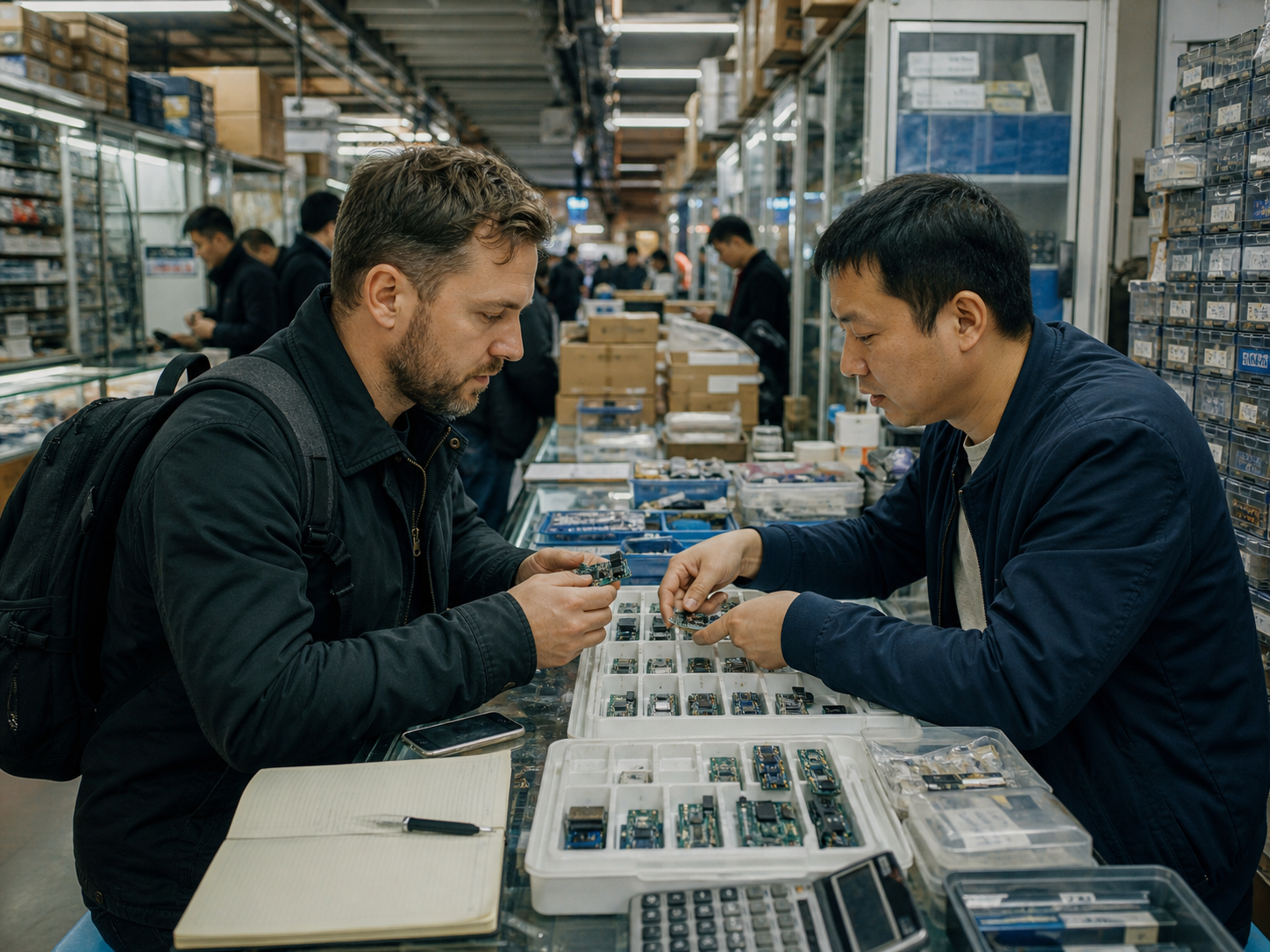
Batteries are the highest-stakes category in hardware sourcing. They drive runtime, weight, cost, safety, and certification at once. The Pearl River Delta, with Huizhou and Pingshan as anchors plus pack assembly across Bao’an, holds one of the densest battery ecosystems outside CATL’s home base. Cell makers, BMS designers, pack assemblers, and testing labs sit inside a 50km radius. For a hardware founder, that means custom packs in 6–10 weeks with proper certification, at unit economics few other geographies match.
What this covers
This page covers lithium-based rechargeable cells and packs: cylindrical Li-ion (18650, 21700, 26650), LiPo pouch (any custom dimension), and LFP (LiFePO4) in cylindrical or prismatic format. It covers BMS design and integration, certification (UN38.3, IEC 62133, UL 1642/2054), and pack assembly with spot welding, ultrasonic welding, or laser welding. It does not cover primary (non-rechargeable) cells, lead-acid, NiMH, or solid-state cells; those have separate supply chains.
What Shenzhen and the PRD do well
- Cell breadth. Every common chemistry and form factor is available from Huizhou or Pingshan, often with multiple tier-1 alternatives. Custom LiPo pouch dimensions can be tooled in 4–6 weeks.
- Pack assembly density. Hundreds of pack assemblers in Bao’an and surrounding districts, with spot-welders, BMS bonding lines, and final pack testing under one roof.
- BMS ecosystem. Off-the-shelf BMS for any common s-count and current rating; custom BMS design houses with 1–2 week firmware iteration cycles.
- Certification logistics. Accredited labs in Shenzhen and Dongguan run UN38.3, IEC 62133, and UL tests on a 4–6 week cycle. Pre-certification consultancy is mature.
Sub-categories
| Sub-category | Format | Typical use | Cluster |
|---|---|---|---|
| Cylindrical Li-ion (NMC, NCA) | 18650, 21700, 26650 | Power tools, e-bikes, consumer electronics | Huizhou |
| LiPo pouch | Custom dimensions | Wearables, drones, slim devices | Pingshan |
| LFP cylindrical | 18650, 26650, 32700 | E-bikes, storage, applications needing cycle life | Huizhou |
| LFP prismatic | Custom | Stationary storage, EV-adjacent | Huizhou + outside PRD |
| Off-the-shelf BMS | 1S–13S, 1–100A continuous | General use | Bao’an |
| Custom BMS | Any s-count, with comms | High-volume custom packs | Bao’an + Longgang |
| Pack assembly | Welded packs with BMS and casing | All applications | Bao’an + Huizhou |
| Cell testing & matching | Capacity, IR, self-discharge sorting | Production lots | Huizhou + Pingshan |
MOQs and lead times
| Item | MOQ | Lead time |
|---|---|---|
| Cylindrical Li-ion / LFP cells, stock | 500 cells | 1–2 weeks |
| Cylindrical cells, custom labelling | 5,000 cells | 4–6 weeks |
| LiPo pouch, off-the-shelf dimensions | 500–1,000 cells | 2–4 weeks |
| LiPo pouch, custom dimensions | 2,000–5,000 cells | 6–10 weeks (tooling + first batch) |
| Off-the-shelf BMS | 500 pieces | 1–2 weeks |
| Custom BMS (after design) | 1,000 pieces | 4–6 weeks |
| Custom BMS NRE | n/a | 3–6 weeks design + 2–4 weeks first sample |
| Pack assembly (simple 1S/2S) | 500 packs | 3–5 weeks |
| Pack assembly (complex, 4S+ with BMS) | 1,000–2,000 packs | 6–10 weeks |
| UN38.3 testing | per design | 4–6 weeks |
| IEC 62133 testing | per design | 6–10 weeks |
Price bands
All prices at the stated quantity, ex-works Pearl River Delta, May 2026. USD conversions at ¥7.2.
Cells (per cell, before pack assembly)
| Cell | Capacity / Wh | 1,000 cells | 10,000 cells |
|---|---|---|---|
| 18650 NMC, 3,000 mAh | 11 Wh | ¥6.50–9 (USD 0.90–1.25) | ¥5.50–7.50 (USD 0.76–1.04) |
| 18650 NMC, 3,500 mAh | 12.6 Wh | ¥8–11 (USD 1.11–1.53) | ¥7–9.50 (USD 0.97–1.32) |
| 21700 NMC, 5,000 mAh | 18 Wh | ¥11–15 (USD 1.53–2.08) | ¥9.50–13 (USD 1.32–1.81) |
| LiPo pouch, 1,000 mAh standard | 3.7 Wh | ¥4–6 (USD 0.55–0.83) | ¥3–5 (USD 0.42–0.70) |
| LiPo pouch, 5,000 mAh standard | 18.5 Wh | ¥18–28 (USD 2.50–3.90) | ¥15–22 (USD 2.08–3.05) |
| LFP 18650, 1,500 mAh | 4.8 Wh | ¥5–7 (USD 0.70–0.97) | ¥4–6 (USD 0.55–0.83) |
| LFP 26650, 3,000 mAh | 9.6 Wh | ¥10–14 (USD 1.39–1.94) | ¥8.50–12 (USD 1.18–1.67) |
Per-Wh blended pricing for typical packs (cells + BMS + assembly)
| Pack chemistry | 1,000 packs | 10,000 packs |
|---|---|---|
| Cylindrical Li-ion pack | ¥0.55–0.85 / Wh (USD 0.08–0.12) | ¥0.45–0.70 / Wh (USD 0.06–0.10) |
| LiPo pouch pack | ¥0.70–1.10 / Wh (USD 0.10–0.15) | ¥0.55–0.90 / Wh (USD 0.08–0.13) |
| LFP cylindrical pack | ¥0.40–0.70 / Wh (USD 0.06–0.10) | ¥0.32–0.55 / Wh (USD 0.04–0.08) |
BMS pricing
| BMS spec | 1,000 units | 10,000 units |
|---|---|---|
| 1S, 3A protection IC + FET | ¥1.50–3 (USD 0.21–0.42) | ¥1–2.20 (USD 0.14–0.31) |
| 2S, 5A standard BMS | ¥3.50–6 (USD 0.49–0.83) | ¥2.80–4.80 (USD 0.39–0.67) |
| 4S, 20A with balancing | ¥12–22 (USD 1.67–3.05) | ¥9–17 (USD 1.25–2.36) |
| 10S, 30A with SMBus | ¥35–65 (USD 4.86–9.03) | ¥28–50 (USD 3.89–6.94) |
| 13S, 50A with active balance | ¥75–140 (USD 10.40–19.45) | ¥60–110 (USD 8.33–15.28) |
Specs to lock down
- Cell chemistry, format, manufacturer (named), nominal capacity, nominal voltage, max charge/discharge rate
- Cycle life target (typically 500 cycles @ 80% retention for consumer, 1,000+ for premium, 2,000+ for LFP applications)
- Operating temperature range (charge and discharge separately, charge below 0°C damages most Li-ion)
- Pack configuration (XSYP, series and parallel count)
- BMS spec: continuous current, peak current, protection thresholds, balancing method, communication protocol
- Connector type and pinout, wire gauge sized for continuous current with margin
- Pack mechanical: case material, drop rating, ingress protection (IPX rating)
- Labelling: capacity in Wh, voltage, manufacturer, date code, UN38.3 reference
- Shipping state of charge (30% for air freight is standard)
- Certifications required by destination market
Process
- Application spec: voltage, capacity, current draw profile, runtime target, form factor, environment.
- Cell selection, typically two candidate chemistries with trade-offs sketched out.
- BMS selection or custom design.
- Pack mechanical design (3D model + 2D drawing) with welding map.
- P1 sample: hand-assembled prototype with stock cells and reference BMS.
- Capacity, IR, and basic safety testing on P1.
- P2 sample: production-intent build with final BMS and casing.
- Full safety testing on P2 (drop, vibration, thermal, overcharge, short).
- UN38.3 and IEC 62133 testing at an accredited lab.
- P3 sample for cosmetics and FAI sign-off.
- Production run, with capacity, IR, and OCV testing on every cell before assembly.
- Final pack functional test, voltage check, and shipping state-of-charge adjustment.
QC specifics
- Incoming cell inspection: capacity (≥95% of nameplate at 0.5C), internal resistance (within ±15% of typical), open-circuit voltage (within ±20mV across the batch), self-discharge (<3%/month).
- Cell matching for multi-cell packs: capacity within ±2%, IR within ±10%.
- Welding inspection: pull-test on spot welds (target >1.5kg per weld), visual for cold welds or splatter.
- BMS functional test: trigger every protection (over-voltage, under-voltage, over-current, over-temperature, short circuit) on every pack.
- Final pack: voltage, IR, capacity (sample basis), shipping voltage trimmed to spec.
- Lot-level documentation: cell batch numbers, BMS lot, assembly date, test results.
What goes wrong
- Capacity overstatement (10–20%). Mitigation: in-house cycler verification on 5–10 cells per batch; reject batch on >5% miss.
- Counterfeit or refurbished cells. Mitigation: buy direct from tier-1 cell maker, demand date codes, spot self-discharge testing.
- Fake UN38.3 reports. Mitigation: verify with the testing lab directly using the report number, demand the original test data not just the summary.
- BMS failing to balance. Mitigation: monitor cell voltages on a sample basis after 50 cycles, demand ±20mV balance.
- Weld failures from over-current. Mitigation: spec wire gauge with 50% headroom on continuous current, ultrasonic-weld critical interconnects.
- Swelling LiPo from overcharge or heat. Mitigation: BMS must cut off at 4.20V max per cell, never operate above 60°C, design mechanical clearance for 10% swelling.
- Air-freight rejection at the airport. Mitigation: 30% SoC, UN38.3 report on every package, lithium battery labelling on outer carton, work with a freight forwarder experienced with batteries.
Certifications
- UN38.3, mandatory for air freight of any lithium battery globally. ¥8,000–25,000, 4–6 weeks.
- MSDS / SDS (material safety data sheet), accompanies every shipment.
- 1.2m drop test as part of UN38.3 plus end-product testing.
- IEC 62133, international consumer battery safety; required for CE marking. ¥15,000–40,000.
- UL 1642 (cell) and UL 2054 (pack), required for US market. ¥30,000–60,000.
- KC for Korea, PSE for Japan, CB scheme for streamlined multi-country.
- CCC for China domestic sale (less common for export-only products).
- UN3480 / UN3481 classification codes for shipping documentation.
Trade shows
- CIBF (China International Battery Fair), Shenzhen or Shanghai, alternating, biennial in spring. The dominant battery industry show in China.
- The Battery Show Asia, Shenzhen, August. International format, growing presence.
- HKTDC Electronics Fair, April and October. Battery pack assemblers and BMS makers exhibit alongside their electronics customers.
- Canton Fair, April and October. Broad; useful for cross-referencing pack assemblers.
- ELEXCON, Shenzhen, late summer. BMS chip suppliers and design houses are well represented.
When to use us
Battery sourcing concentrates more risk per dollar than any other hardware category. Capacity overstatement, fake certifications, and silent cell substitution all show up months after production. The sourcing desk handles tier-1 cell maker introductions, BMS spec review, UN38.3 lab coordination, and in-house capacity verification testing. The hardware founder tour is the in-person version: walking Huizhou cell lines, watching pack assembly in Bao’an, and meeting the testing labs that will sign off your UN38.3.
Last reviewed: 23 May 2026.
Frequently asked questions
Should I use 18650, 21700, or LiPo pouch cells?
Cylindrical 18650 is the workhorse: best price per Wh, broad supplier base, physically tough, easy to assemble into packs. 21700 is the newer cylindrical format with roughly 50% more capacity per cell, increasingly standard in power tools and EVs. LiPo pouch fits shape-constrained applications (wearables, slim devices) and cases where weight matters more than absolute cost. LFP (LiFePO4) trades energy density for safety and cycle life, suiting stationary storage, e-bikes where range is adequate, and applications where thermal runaway is a dealbreaker.
Why does cell capacity from a Shenzhen supplier sometimes test 10–20% lower than the spec?
Three reasons. First, supplier datasheets often state typical capacity under ideal lab conditions (0.2C discharge, 25°C); your application probably runs hotter and faster. Second, less reputable suppliers state nameplate capacity the cell never delivers. Third, cells degrade in storage, so a 'fresh' cell that's been sitting six months tests lower. Mitigation: test capacity in-house on 5–10 random cells from every batch with a calibrated cycler, accept at least 95% of nameplate at 0.5C discharge, reject the batch otherwise.
What's involved in UN38.3 certification?
UN38.3 is the UN test specification for lithium battery air transport. It covers eight tests: altitude simulation, thermal test, vibration, shock, external short circuit, impact/crush, overcharge, and forced discharge. The test takes 4–6 weeks at an accredited lab and costs ¥8,000–25,000 depending on cell vs pack and lab choice. The deliverable is a test summary report; every shipment must reference it. Counterfeit UN38.3 reports exist; verify by contacting the testing lab directly. Some suppliers offer to 'share' an existing report for a similar product. That's not legal and customs will catch it.
What does a BMS (battery management system) do, and do I need one?
A BMS protects the pack against overcharge, over-discharge, short circuit, over-current, over-temperature, and cell imbalance. Any multi-cell Li-ion or LiPo pack needs one; running cells unbalanced is unsafe. Single-cell LiPo applications can use a simple protection IC instead. Spec the BMS by chemistry, number of series cells (s-count), continuous current, peak current, and any communication required (SMBus, I2C, UART). Off-the-shelf BMS from a Bao'an supplier costs ¥3–25 depending on s-count and current; custom BMS adds NRE of ¥30,000–80,000 plus per-unit cost.
What's the realistic minimum order for a custom battery pack?
500 packs for a simple 1S or 2S LiPo with off-the-shelf BMS, 1,000–2,000 packs for anything custom. Below 500, suppliers will quote but margin is thin and lead time stretches. NRE for a custom pack (mechanical design, BMS integration, UN38.3 testing) runs ¥40,000–120,000 separately from per-unit cost. Plan for at least three sample iterations: P1 for fit and function, P2 for safety testing, P3 for cosmetics and final approval.
How do I avoid getting fake or refurbished cells?
Buy direct from a Huizhou or Pingshan tier-1 cell maker, or insist your pack assembler uses cells from a named manufacturer with batch traceability. Demand cell labels with date code and manufacturer logo intact. Spot-test capacity, internal resistance, and self-discharge on 5–10 random cells per batch. Refurbished cells typically show high self-discharge (>3%/month) and inconsistent internal resistance. For high-stakes products, send 2–3 cells from each batch for third-party teardown and material analysis (¥2,000–5,000 per cell).