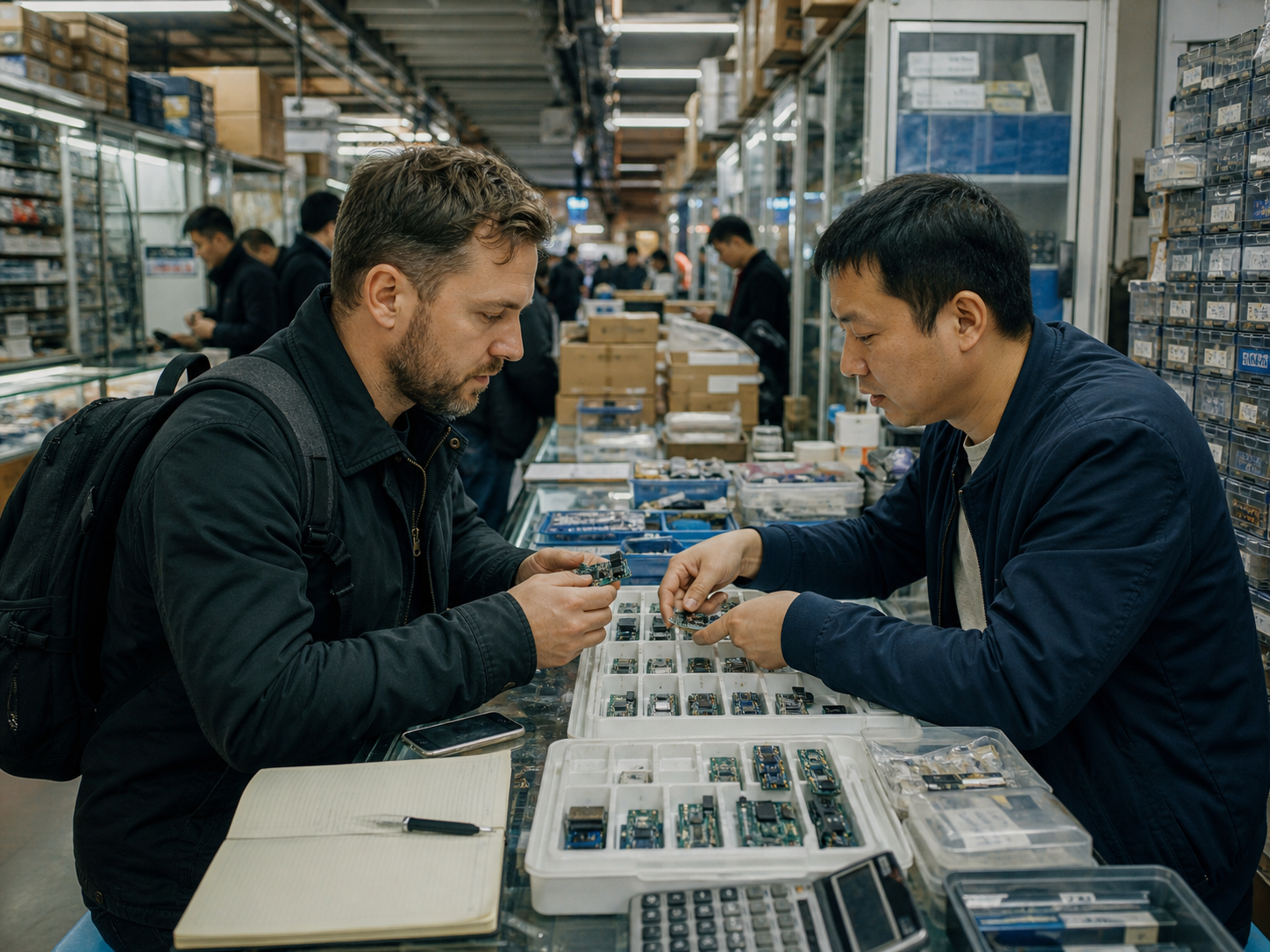
Shenzhen is the world’s component capital. Huaqiangbei alone hosts thousands of component traders across multiple buildings, with stock depth no single distributor can match. Layered on top is the authorised distribution channel: LCSC headquartered locally, plus Digi-Key and Mouser distribution warehouses regionally, and direct factory relationships for high-volume custom parts. The three channels coexist, each with different trade-offs on cost, traceability, lead time, and risk. Knowing when to use which is the core skill in Shenzhen component sourcing.
What this covers
This page covers electronic components for OEM use: ICs (microcontrollers, analog, RF, power management), passive components (resistors, capacitors, inductors), connectors and cables, sensors (IMU, environmental, image, force), displays (LCD, OLED, e-paper), cameras and image modules, motors (BLDC, stepper, servo, vibration), and antennas (PCB, ceramic, external). It does not cover custom ASICs or full module design; those are separate engineering services.
What Shenzhen and the PRD do well
- Stock depth at Huaqiangbei. When a part is allocated worldwide, stock exists in Huaqiangbei. The cost is verification overhead; the benefit is keeping production running.
- LCSC integration. LCSC is headquartered in Shenzhen with same-day pickup. For Pearl River Delta SMT lines, a part ordered before noon is on the production floor by evening.
- Custom modules. Displays, cameras, antennas, and motors can be ordered as custom variants (different connector pinouts, different cable lengths, different IP ratings) with MOQs from 1,000 pieces.
- Distributor presence. Mouser and Digi-Key both ship from Hong Kong warehouses; customs clearance is straightforward; lead time to Shenzhen is 1–2 business days.
Sub-categories
| Sub-category | Typical channels | MOQ range | Cluster |
|---|---|---|---|
| ICs (MCU, analog, RF, power) | Authorised distributors first, HQB for emergency | 1 (sample) to reel | Authorised + Huaqiangbei |
| Passives (R, C, L) | LCSC for production, HQB for samples | 100 to multi-reel | Authorised + Huaqiangbei |
| Connectors | LCSC, HQB for obscure | 1 (sample), 1,000+ (reel) | Authorised + Huaqiangbei |
| Sensors (IMU, env, image) | Module suppliers + authorised IC | 100–1,000 typically | Bao’an + Longgang module makers |
| Displays (LCD, OLED, e-paper) | Direct from display factories | 500–2,000 for stock, 5,000+ for custom | Longgang + Dongguan |
| Camera modules | Module suppliers | 1,000–5,000 | Bao’an specialists |
| Motors (BLDC, stepper, servo) | Motor factories direct | 500–2,000 | Bao’an + Dongguan |
| Antennas | Antenna design houses | 1,000 (custom design, after tuning) | Bao’an |
| Cables and harnesses | Custom assembly shops | 500–2,000 | Bao’an + Dongguan |
MOQs and lead times
| Item | MOQ | Lead time |
|---|---|---|
| LCSC stock components | 1 piece (cut tape) | Same day to 2 days |
| Authorised distributor (DK, Mouser) | 1 piece | 2–4 days from HK warehouse |
| Huaqiangbei spot market (passives) | 1–100 pieces | Same day |
| Huaqiangbei spot market (ICs) | 1–1,000 pieces | Same day to 3 days |
| Custom display (existing controller) | 500–2,000 | 4–6 weeks |
| Custom display (new tooling) | 5,000+ | 10–14 weeks |
| Custom camera module | 1,000–5,000 | 6–10 weeks |
| Custom motor (winding spec) | 500–2,000 | 6–10 weeks |
| Custom antenna design + tune | 1,000 (after design) | 3–4 weeks design, 2–3 weeks tooling |
| Custom cable assembly | 500–2,000 | 2–4 weeks |
Price bands
All prices ex-works Shenzhen, May 2026. USD conversions at ¥7.2. Spot-market and reel pricing vary widely; ranges below are representative for common parts.
| Component | LCSC / authorised reel | Huaqiangbei spot |
|---|---|---|
| 0603 ceramic cap, 100nF, X7R | ¥0.012–0.025 per piece (USD 0.0017–0.0035) | ¥0.008–0.018 per piece |
| 0603 resistor, 1% | ¥0.008–0.015 per piece | ¥0.005–0.012 per piece |
| Common MCU (STM32G0 class) | ¥8–18 per piece (USD 1.10–2.50) | ¥6–14 per piece — verify authenticity |
| Power MOSFET (general purpose) | ¥1.50–4 per piece | ¥1–3 per piece |
| BLE 5.0 module (Nordic / Realtek class) | ¥18–35 per piece (USD 2.50–4.85) | ¥14–28 per piece |
| 2.4” TFT LCD module, stock | ¥35–80 per piece (USD 4.85–11.10) | ¥30–65 per piece |
| 2MP camera module, stock | ¥25–55 per piece (USD 3.47–7.65) | ¥20–45 per piece |
| BLDC motor (24V, 50W class) | ¥120–280 per piece (USD 16.70–38.90) | n/a (factory direct) |
| Stepper motor NEMA 17 | ¥45–95 per piece (USD 6.25–13.20) | ¥35–80 per piece |
| USB-C connector | ¥1.50–4 per piece | ¥1–3 per piece |
| Custom display, 5” IPS 800×480 | ¥110–220 per piece at 5,000 MOQ | n/a |
| Custom 1.5m USB-A to USB-C cable | ¥3–8 per piece at 2,000 MOQ | n/a |
Specs to lock down
- Manufacturer part number (MPN), never accept “equivalent” without explicit approval
- Authorised distributor source, name it
- Date code requirement, typically within 18 months of production
- Packaging: reel, tape, tube, tray
- Quality grade: commercial, industrial, automotive
- Temperature rating (commercial 0–70°C, industrial -40–85°C, automotive AEC-Q100/Q200)
- Tolerance / specification grade for passives
- For modules: pin compatibility, firmware version, certification (FCC, CE, KC)
- For displays: viewing angle, brightness, touch type, interface (MIPI, RGB, SPI)
- For motors: torque curve, RPM range, encoder type, IP rating
- Lead time and second source identified
Process
- BOM compilation with MPN, manufacturer, quantity, package, and notes per line.
- Quote three sources per critical part: authorised distributor, alternate authorised, Huaqiangbei reference.
- Lead-time analysis, flag any part on allocation, plan buffer accordingly.
- Sample procurement for design verification: usually 5–10 of each part from authorised source.
- Pilot build with full production-spec parts.
- Production purchase orders against locked sources, with date-code requirements.
- Incoming inspection: package verification, date code, lot code, visual.
- Spot verification on critical parts: X-ray for BGA, microscope inspection for marking, electrical test if practical.
- Inventory management: temperature/humidity-controlled storage for MSD (moisture-sensitive devices), FIFO rotation.
QC specifics
- Date-code verification on every reel, reject parts older than spec.
- Authenticity verification on high-value ICs: laser-mark comparison, X-ray of BGA balls, decap analysis on samples.
- Reel and packaging condition: undamaged, MBB (moisture-barrier bag) intact, desiccant fresh.
- Electrical sampling: per AQL 1.0 for active components, AQL 2.5 for passives.
- For modules: functional test on every unit (typical: power-on, basic comms test, sleep current).
- Traceability: cell / lot / batch numbers logged at receipt, linked to production lots that consumed them.
What goes wrong
- Counterfeit ICs from Huaqiangbei spot. Mitigation: prefer authorised distribution for any IC over ¥5; X-ray and decap verification on critical parts; lock supplier in writing.
- Refurbished ICs marked as new. Mitigation: 10× loupe inspection of laser marks for sanding or remarking; reject any inconsistent date codes; demand original manufacturer reels not loose-cut tape.
- Silent BOM substitution by assembler. Mitigation: lock MPN per line item; written change-control process for any substitution; first-article verification after any change.
- Lead-time surprise on allocation parts. Mitigation: continuous monitoring of lead times on critical parts; design-in second sources at engineering stage; carry 3–6 month buffer on allocation-prone parts.
- Moisture damage on MSD parts. Mitigation: keep MBB sealed until use; bake parts per JEDEC J-STD-033 if exposed >168 hours; verify humidity-indicator cards on receipt.
- Date-code spread across one reel. Mitigation: spec single-date-code reels (premium of 5–15%); verify on receipt; reject mixed reels.
- Custom module shipped with wrong firmware version. Mitigation: written firmware version spec; functional test on incoming verifies version; lot-level firmware logging.
Certifications
- RoHS / REACH declarations from the manufacturer, standard for all reputable parts.
- AEC-Q100 / Q101 / Q200 for automotive-grade components, premium of 30–100% over commercial parts.
- MIL-STD-883 for military / high-reliability parts, narrow supplier base, long lead time.
- MSL (Moisture Sensitivity Level) rating per JEDEC, affects handling and shelf life.
- FCC / CE / KC / TELEC for RF modules, required for end-product certification, often pre-certified in the module.
- UL recognition for components in mains-voltage applications.
- Manufacturer certificate of conformance on every shipment for critical parts.
Trade shows
- HKTDC Electronics Fair (April, October), components occupy multiple halls, both passives and modules.
- electronicAsia (Hong Kong, October), co-located with HKTDC, more component-focused.
- ELEXCON (Shenzhen, late summer), domestic component ecosystem, deep on Chinese chipmakers and module designers.
- Productronica China (Shanghai, March, biennial), process side, but component vendors exhibit.
- Canton Fair Phase 1 (April, October), broad, useful for module and cable assembly suppliers.
When to use us
Component sourcing concentrates the risk that quietly destroys hardware launches: counterfeit parts, allocation surprises, silent substitutions, and date-code drift. The sourcing desk handles BOM scrubbing, distributor authentication, lead-time analysis, and incoming inspection protocol design. Most of the value lands remotely. The hardware founder tour is the in-person version, including walks through Huaqiangbei with a guide who knows which traders are reliable for which categories.
Last reviewed: 23 May 2026.
Frequently asked questions
When should I use Huaqiangbei vs LCSC / Digi-Key for components?
Huaqiangbei wins in three scenarios: (1) sample quantities of obscure parts where MOQ from distributors is too high, (2) instant pickup when you need a part this afternoon, and (3) commodity passives where price matters and counterfeit risk is low. LCSC, Digi-Key, and Mouser win on everything else: traceability, full reel quantities, real datasheets, and zero counterfeit risk. For production runs, default to authorised distribution and only deviate for specific reasons. The 20–40% spot-market savings on passives don't justify the 5–10% counterfeit IC risk on critical components.
How do I tell a counterfeit IC from a genuine one?
Counterfeit ICs typically show one or more red flags: laser marks that don't match the manufacturer's font or date-code format, sanded-and-remarked tops (visible under angled light), inconsistent ball geometry under X-ray for BGA packages, package dimensions slightly off from datasheet, and date codes that don't match the actual production timeline. The most reliable check is comparing the X-ray die image to a reference from the manufacturer. For high-value chips, send 2–3 samples for decap and die analysis. ¥1,500–4,000 per part but worth it on critical designs.
What's a 'reel quantity' and why does it matter for pricing?
Components ship on reels for automated pick-and-place. Common reel sizes are 3,000 / 5,000 / 10,000 pieces depending on package. Buying a full reel gets you the manufacturer's volume pricing tier; buying partial quantities (cut tape) costs 30–80% more per unit and may incur handling fees. For production planning, calculate exact reel quantities up front. Buying 5,500 pieces means paying for two reels (10,000 total) or paying premium cut-tape pricing on the extra 500. A Pearl River Delta SMT line will quote you better pricing if you stay in full-reel multiples.
Can I bring my own components to an assembler, or should they source them?
Both work, with different trade-offs. Customer-supplied parts (consignment) give you full control over sourcing and quality but expose you to all shortage risk and tie up cash in inventory before assembly. Assembler-sourced parts let the SMT line manage shortages, often pulling from their own stock, and put quality responsibility on them. For mass production, a mixed model is common: customer supplies the critical / expensive parts (main MCU, RF modules) and the assembler sources everything else from their stocked passives library. Lock the model upfront. Switching mid-production is painful.
How do I handle component shortages without redesigning?
Three strategies. First, design with multi-source parts wherever possible: for every critical IC, identify and qualify a second-source equivalent during design. Second, monitor lead times on key parts continuously; the warning signs are typically 6–12 weeks before stockout. Third, build a 6–12 month buffer of allocation-prone parts (advanced MCUs, specialty analog). Yes, capital-intensive, but cheaper than a redesign in the middle of a production run. Huaqiangbei spot market is the emergency channel: stock often exists there 3–6 months before it returns to authorised distribution. The risk is exactly the counterfeit and refurbished problem; use it knowingly.
Why does the same part cost different amounts from different LCSC / Mouser suppliers?
Distributor margins differ by region, by relationship, and by purchase volume. Some distributors are paying for marketing programs that show up as price differentials. Others are not authorised for that specific part-line, which means stock could be from grey market sources even if presented as new. For critical parts, verify authorisation directly with the component manufacturer's website. Every IC company publishes a list of authorised distributors per region. Pay the premium for authorised channels on anything that matters.