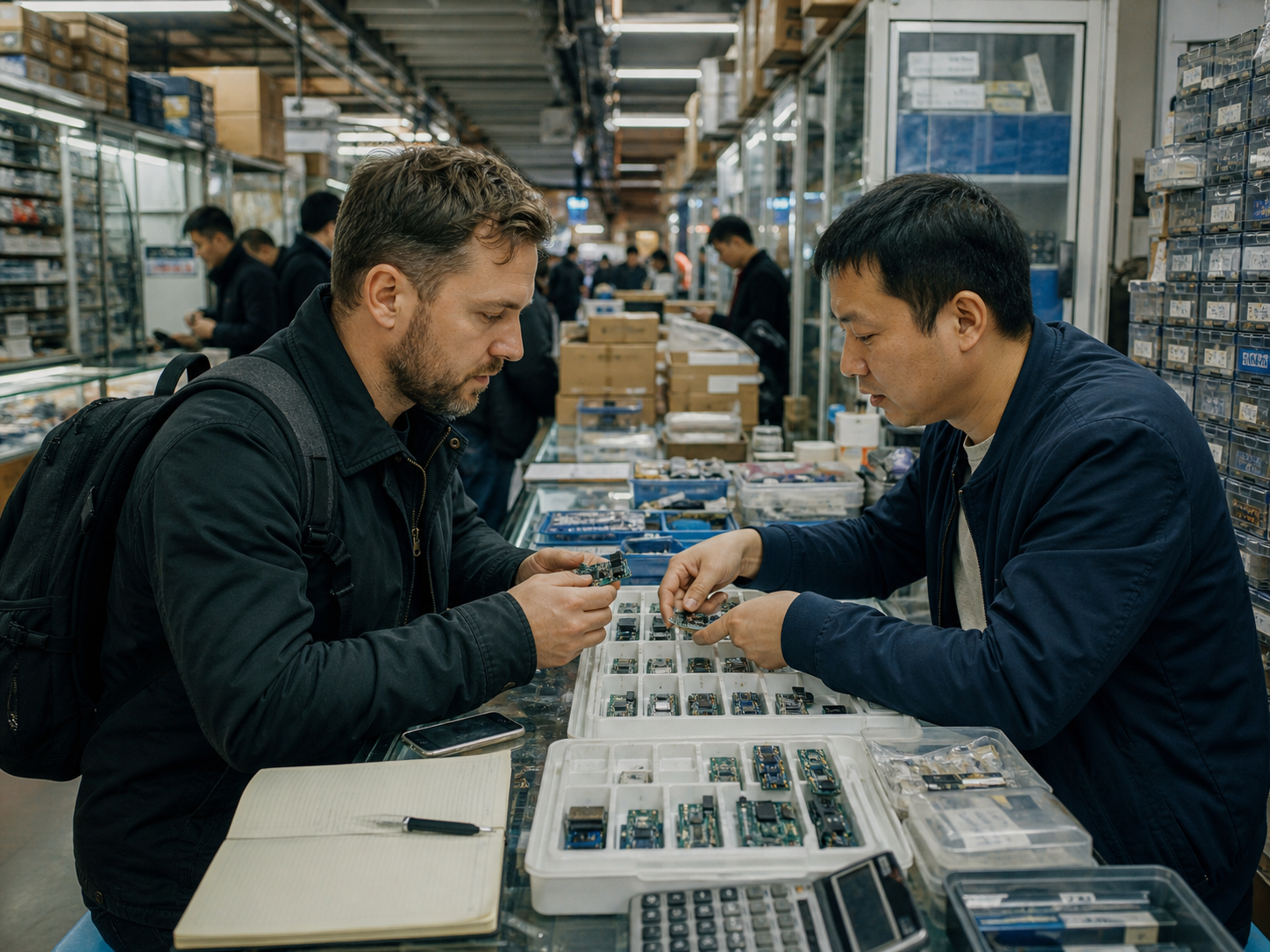
Shenzhen is infrastructure, not magic. For hardware founders, the city can compress learning cycles by 6–12 months, expose supply chains, reveal existing modules, speed prototyping, and make manufacturing feel less abstract. It can also waste your time if you arrive without a factory brief, clear specs, or a sourcing plan.
Six weeks before your first trip: the pre-work
You cannot meaningfully source suppliers without knowing what you need. Six weeks out, complete the following.
1. Write a factory brief
Your factory brief is a document with twelve specific fields that every supplier needs. See the detailed factory brief guide for the full template and a worked example. In short:
- Product name and function (one sentence)
- Target retail and landed cost (e.g. ¥500 retail, ¥110 FOB)
- Monthly volume and 12-month forecast (e.g. 1,000/month, 12,000 year one)
- Dimensions, weight, materials, finish (with tolerance notes)
- Certifications required (FCC, CE, RoHS, ISO 9001, industry-specific)
- Packaging (carton size, inserts, labels, volume requirements)
- Target ship date and mode (sea/air, port/airport)
- Revision acceptance (what can change between samples and production)
This is a 2–3 page document with drawings, BOMs, and reference images. Spend 40–60 hours building it. It is the foundation of every conversation.
2. Map your sourcing approach
Three paths to finding suppliers. Understand the tradeoffs.
| Path | Pros | Cons | Timeline |
|---|---|---|---|
| Alibaba + Made-in-China + Global Sources | Fast (3–5 qualified leads in a week), visible certifications and audit reports, can message 50+ factories, cheap outreach | Many unqualified responses, no on-ground verification, lead quality varies wildly, negotiation takes 2–4 weeks | 4–6 weeks |
| Trade shows (HKTDC Electronics Apr/Oct, Canton Fair Apr/Oct) | Face-to-face meetings, side-by-side reference products, faster negotiation, qualified booth presence | Crowded floors, many staff are salespeople (not engineers), heavy follow-up after, cost of show prep | 3–5 months (next show) |
| Ground discovery (Huaqiangbei + sourcing assistant) | Real pricing, immediate reference products, supplier ecosystem visible, can start sample conversations same day | Requires 5–10 days in Shenzhen, translator fees (¥800–2,000/day), slower for complex categories | 2–4 weeks discovery + 2–4 weeks follow-up |
| Sourcing partner / agent | Vetted suppliers, sample logistics handled, IP agreements pre-set, ongoing relationship management, saves 6–12 months | Costs 5–10% of first order, reduces direct supplier relationship, agent interests may not perfectly align with yours | 2–3 weeks to qualified suppliers |
Typical playbook for a first-time hardware founder: Alibaba + Made-in-China outreach (weeks 1–2) → narrow to 5–8 qualified leads (weeks 2–3) → ground discovery trip to meet top 3 in person and walk Huaqiangbei (weeks 3–4) → paid samples from top 2 (weeks 4–6) → evaluate, begin production negotiation (weeks 6–10).
Supplier qualification: the audit checklist
Before you send a factory a ¥50,000 production order, you need to know if they can deliver. A supplier qualification checklist catches red flags fast.
Years in operation
- Under 3 years = higher risk (may not survive cash-flow pressure); ask harder questions about process stability.
- 5+ years = lower risk; ask for customer references (category and volume, not necessarily names).
Process lines and infrastructure
- How many production lines does the factory have?
- Are lines dedicated to your category or shared? (Shared = scheduling risk.)
- What is the largest batch they have run in your category? (Minimum: 3× your MOQ, or they are new to the category.)
Certifications and compliance
- ISO 9001 (quality management): baseline expectation.
- ISO 14001 (environmental): expect this for consumer electronics.
- RoHS (lead-free): mandatory for EU/US consumer electronics.
- FCC / CE / UL (product certification): varies by category; confirm they have experience with your specific regulatory path, not just a generic “we have CE.”
- IATF 16949 (automotive): only if automotive; indicates strong quality discipline.
Ask for copies of certifications, actual certificates issued by third parties (SGS, TÜV SÜD, Intertek, Bureau Veritas), not screenshots in an email. Fake certificates are common.
Sample sequence (the most important signal)
A good supplier has a process. A bad supplier is chaotic.
- Paid sample (¥500–5,000): you pay full engineering cost. Factory makes 1–5 samples. Timeline: 2–4 weeks. Quality: 80–90%.
- Golden sample (¥2,000–10,000): after revision, you approve one sample as the “golden.” Factory holds it as reference. Timeline: 1 week.
- Pilot 50 (¥5,000–20,000): factory runs 50 units through the real production process. Quality should be 95%+. Timeline: 2–3 weeks. This is your real test.
- Pilot 500 (¥15,000–50,000): pre-production run. Catch tooling drift, material variance, assembly problems. Timeline: 3–4 weeks. Quality: 98%+.
- Mass production (1,000+): full commitment. Timeline: 4–8 weeks after pilot approval.
Red flag: a supplier who says “we will go straight to production, no samples.” Drop them.
MOQ and lead time reality by category
These are real numbers, not theoretical minimums.
| Category | MOQ (units) | Tooling time | Production lead time | Sample cost |
|---|---|---|---|---|
| CNC machining (Bao’an CNC shop) | 1–50 | None | 2–4 weeks | ¥500–2,000 |
| Sheet metal | 50–200 | 1–2 weeks (dies) | 2–4 weeks | ¥800–3,000 |
| Injection moulding (tier-1 mainland mould maker) | 500–5,000 per cavity | 4–8 weeks | 6–12 weeks | ¥5,000–30,000 |
| Die casting | 1,000–5,000 | 4–6 weeks | 6–10 weeks | ¥3,000–15,000 |
| PCBA prototype | 5–100 | None | 1–2 weeks | ¥100–500 |
| PCBA production (Pearl River Delta SMT line) | 500+ | 1–2 weeks (setup) | 2–3 weeks | ¥200–1,000 |
| Battery cells | 1,000+ | None | 2–3 weeks | ¥50–200 per sample |
| Textiles / soft goods | 300–1,000 | 1–2 weeks (cutting dies) | 3–6 weeks | ¥500–2,000 |
| Packaging (printed carton) | 1,000–5,000 | 1 week (artwork + dies) | 2–4 weeks | ¥200–1,000 |
Key insight: injection moulding is the bottleneck for most consumer hardware. If your product has a custom enclosure, add 12–16 weeks to your timeline before units are in hand. Budget ¥15,000–50,000 for tooling alone.
Payment terms and risk
Chinese manufacturers expect payment in one of three structures.
T/T (telegraphic transfer / wire)
- 30/70: 30% deposit on order confirmation, 70% before shipment. Most common.
- 50/50: 50% deposit, 50% before shipment. For new relationships or smaller suppliers.
- 100% upfront: rare; indicates a small supplier with cash-flow constraints. Walk away unless you have other verification.
Risk: you prepay; if the supplier underdelivers, recourse is limited. Mitigate with photo/video evidence before final payment, third-party inspection, and TradeAssurance for orders under $100k.
Alibaba TradeAssurance (Alibaba suppliers only)
Platform escrow; funds release to supplier only after you confirm receipt and quality. Fee built into the listing. Limit typically $50k–$100k per order. Best protection for smaller first orders.
Letter of credit (LC)
Bank guarantees payment if the supplier ships conforming goods. Standard for orders over $100k. Bank fee 1–2%, setup 5–7 days. Maximum protection, slow and expensive. Worth it on large orders.
Recommended playbook for a first order:
- Under $20k: Alibaba TradeAssurance if available, otherwise 50/50 T/T with third-party inspection.
- $20k–$100k: 30/70 T/T plus third-party pre-shipment inspection (or TradeAssurance where it fits).
- Over $100k: 30/70 T/T plus third-party inspection, with the final 30% released via LC.
Quality control: standards and inspection
Chinese manufacturers have a different QC philosophy than Western ones. Set expectations early.
Standard: AQL 2.5, Level II (ANSI/ASQ Z1.4 / ISO 2859). For every 1,000 units, accept a maximum of six minor defects. This is industry standard for consumer electronics. Do not negotiate it. If a supplier offers “better” AQL without specifics, they are misunderstanding or selling air.
Three-point inspection
- In-line: during production, sample 3–5% of output, test functionality, fix issues in real time.
- Pre-shipment: final 100% visual or 10% functional test on finished product.
- Container loading: randomly sample 5–10 units from each carton as it is loaded.
Who does QC?
- Factory in-house: fast, cheap, incentive misaligned (factory wants to ship). Acceptable for the first pilot, not for production.
- You or your team on-ground: ¥200–500/day in living cost, requires presence, catches issues immediately.
- Third-party inspector (SGS, Bureau Veritas, Intertek): ¥2,000–5,000 per inspection for consumer products, ¥5,000–15,000 for medical or safety-critical. Neutral party, defensible if a product fails in field.
Recommendation for first production run: factory in-house QC + your presence for 1–2 days during production + third-party pre-shipment inspection if the product is safety-critical (medical, power, automotive). For non-critical consumer goods, factory in-house + your video/photo verification pre-shipment is usually enough.
IP and legal: reality, not theory
NDA vs NNN
- NDA (non-disclosure agreement): factory agrees not to share your designs. Widely ignored in China. Hard to enforce.
- NNN (non-disclosure, non-use, non-circumvention): factory agrees not to disclose, not to make your product for competitors, not to sell your design to others. Stronger. Still not perfectly enforceable, but a serious deterrent.
Use an NNN. Have a China-based lawyer vet it (¥2,000–5,000). Specify (1) what is confidential, (2) how long confidentiality lasts, (3) penalty clause if breached (¥100k+ is standard), (4) dispute resolution in China. Shenzhen arbitration is faster than international court.
IP registration (critical)
- Trademark in China first. ¥200–500, takes 10–12 months, but must happen before you show factories your brand name. China is first-to-file: a factory or troll can register your mark in their name and you lose brand rights in China for that class.
- Design patent in China. ¥500–1,500, 6–8 months. Protects aesthetic design (enclosure shape). Useful for consumer products with a distinctive look.
- Utility patent in China. ¥2,000–5,000, 12–18 months. Protects an invention. Rarely enforced for hardware at small scale; skip unless your tech is defensible at >¥10M scale.
Corporate structure
Most foreign founders do not register a WFOE on trip one. The lighter path:
- Hong Kong limited company for invoicing and USD banking. ¥10–20k setup. No VAT. Most suppliers can accept HK-issued POs and ship on USD T/T.
- WFOE in Shenzhen when you need RMB invoicing, local hires, or a permanent office. ¥30–80k setup plus annual accounting. Worth it past roughly ¥5M/year of China-sourced revenue.
In practice: register your trademark, sign an NNN, set up an HK company, skip patents until you have funding. Do not rely on IP to protect you from cloning; rely on innovation speed and customer preference.
The six-step plan: from idea to first 1,000 units
- Weeks 1–2. Build the factory brief, the twelve-field document, drawings, BOM, target cost and volume, certifications, packaging.
- Weeks 2–4. Outreach: post the brief to Alibaba, Made-in-China, HKTDC contacts, or hand it to a sourcing partner. Expect 50–100 responses. Qualify to top 5–8.
- Weeks 4–5. Ground discovery: visit top 3 suppliers in person (or via video). Negotiate sample pricing. Order paid samples from top 2.
- Weeks 6–8. Sample evaluation: functional testing, fit and finish review, cost validation. Iterate with the top supplier.
- Weeks 8–10. Pilot production: order 50–500 units as a pilot run. Test the full supply chain, tooling, assembly yield, packaging fit, shipping logistics.
- Weeks 10–16. Production ramp: approve pilot, authorise 500–1,000 unit run. Final QC, container loading, shipment. Total elapsed time from concept to 1,000 units in hand: 16–20 weeks.
Tooling, amortization, and unit economics
Tooling is the single biggest cash hit in your first 12 months, and most first-time founders miscount it. A worked example for a consumer plastic enclosure:
- Tool cost (single-cavity injection mould, P20 steel, mainland tier-1 mould maker): ¥35,000.
- Tool life: 300,000 shots before refurbishment.
- Amortization at 10,000 units: ¥3.50/unit.
- Amortization at 50,000 units: ¥0.70/unit.
- Amortization at 100,000 units: ¥0.35/unit.
This is why factories push for higher MOQs, and why your unit cost lies to you at low volume. Three rules:
- Always quote two FOB prices: the “pilot” price (tool amortised over first 5,000) and the “production” price (amortised over 50,000+). Investors and customers ask both.
- Own the tool. Pay the full tool cost; demand a tool ownership certificate (模具所有权证明) in your name. If the factory owns it, they can hold your production hostage when you want to switch suppliers.
- Multi-cavity is a year-two decision. A 4-cavity tool is roughly 2.5× the cost of a 1-cavity tool but quadruples shot output. Only worth it past ~30,000 units/year.
Logistics: getting product out of China
Most first-time founders forget that “FOB Shenzhen” means your problem from the port onwards. Plan it.
- Sea freight (LCL, less than container load): 22–35 days to US west coast, 30–45 days to EU. ~$80–150/cubic metre plus port fees. Best for orders over ~2 m³.
- Sea freight (FCL, full container, 20’/40’): 22–35 days. ~$2,500–5,000 per 20-foot. Cheaper per unit once you’re over ~10 m³.
- Air freight: 5–10 days. $5–8/kg. Worth it only for samples, urgent restocks, or high-value low-weight products.
- DDP (delivered duty paid) via consolidator: 18–30 days, $8–15/kg to the US. The consolidator handles customs, duties, and last-mile. Most expensive per kg but the lowest-friction path for a small team.
- Air courier (DHL/FedEx): 3–5 days, $15–30/kg. For samples and very small batches only.
Budget rule of thumb: freight + duties + last-mile add 15–30% to FOB cost for a consumer product. If your FOB is ¥60, your landed cost is ¥75–85. Build this into your unit economics from week one, not week ten.
US tariffs, HTS codes, and Section 301
If your end market is the US, the right HTS classification can shift your landed cost by 5–25%. Get this right before you ship.
- Find the HTS code for your product on the USITC tariff database. A Bluetooth speaker is typically 8518.22.0000 (multiple loudspeakers in one enclosure), MFN duty ~4.9%.
- Section 301 China tariffs add 7.5–25% on top of MFN for many electronics categories. As of 2025–2026 the structure is still in flux; verify the current rate for your specific HTS code before quoting customers.
- First sale rule. If you buy through a Hong Kong intermediary at a lower invoice price than your final customer pays, you may be able to declare the “first sale” price as the dutiable value. Talk to a customs broker; this can save 10–20% on tariffs.
- De minimis ($800/shipment to the US, currently under policy review) lets you ship small DTC orders direct without paying tariffs. Useful for sampling and first 100 customers; not a strategy for scale.
Hire early (weeks 1–4) if:
- Your BOM has 100+ unique parts or complex supply chain (multiple geographies, special materials).
- Your timeline is under 12 weeks (compressed schedules need expert navigation).
- You have >¥500k in first-year revenue (a 5–10% agency fee is justified).
- Your product needs specific certifications (medical, automotive, safety-critical).
Hire mid (weeks 4–8) if:
- You sourced suppliers yourself but need help with sample negotiation or qualification.
- You need on-ground presence during pilot production (translator + quality assurance).
- Supplier communication is breaking down on language, culture, or engineering spec clarity.
Do it yourself if:
- BOM is simple (<50 parts), timeline is relaxed (>16 weeks), funding is tight, product is non-critical.
If you want help on any of the above, that’s what our sourcing desk and hardware founder tour are built for, including a factory brief review, supplier shortlisting, and on-ground qualification.
Last reviewed: 2026-05-23.
Frequently asked questions
What's the difference between a trading company, factory, and integrator?
A trading company buys from factories, marks up 20–30%, and resells. A factory has production lines and tooling. An integrator (assembly partner) takes components and final-assembles but does not manufacture base materials. For cost and quality, deal with factories directly when possible. Trading companies are useful for sourcing established components: already-made modules, connectors, test equipment.
Can I start with a small MOQ of 10–50 units?
Yes, but per-unit cost is 3–5× higher than production pricing. Use small MOQs for validation only (proving market demand, getting customer feedback, testing supply chain). Once you have validated demand, move to production MOQ. Do not treat the pilot price as your real cost model.
How do I stop a supplier from copying my design and selling to competitors?
You cannot fully prevent it. Mitigation: NNN agreement + fast innovation cycle (ship v2 before knockoffs arrive) + brand loyalty (customer preference beats product specs) + IP registration in China. Most suppliers will not copy if you are a reliable, high-volume customer; they make more from you than from competitors.
What if the supplier's first sample is bad?
Request a revision timeline and cost. If more than two revisions are needed, move to the next supplier on your shortlist. A competent supplier hits spec in 1–2 revisions. If they cannot, they lack engineering depth or do not understand your requirements. Neither is fixable from your side.
Should I visit the factory before placing a large order?
Yes, for any first production order above ¥100k. Walk the lines, meet the engineer and QA manager, review samples, watch the process, validate certifications in person. Cost: ¥1,500–3,000 (flights, hotel, 2 days). Saves: potentially ¥100k+ in a bad production run, plus 6 weeks of clarification by email.
When should I set up a WFOE or Hong Kong trading company?
Most founders do not need a WFOE until they hit ~¥5M/year in China-sourced revenue or need to hire local staff. Until then, a Hong Kong limited company (¥10–20k setup, no VAT, easy USD banking) plus T/T payments to your suppliers is the standard structure. WFOE makes sense once you need RMB invoicing, local hires, or a permanent Shenzhen office.