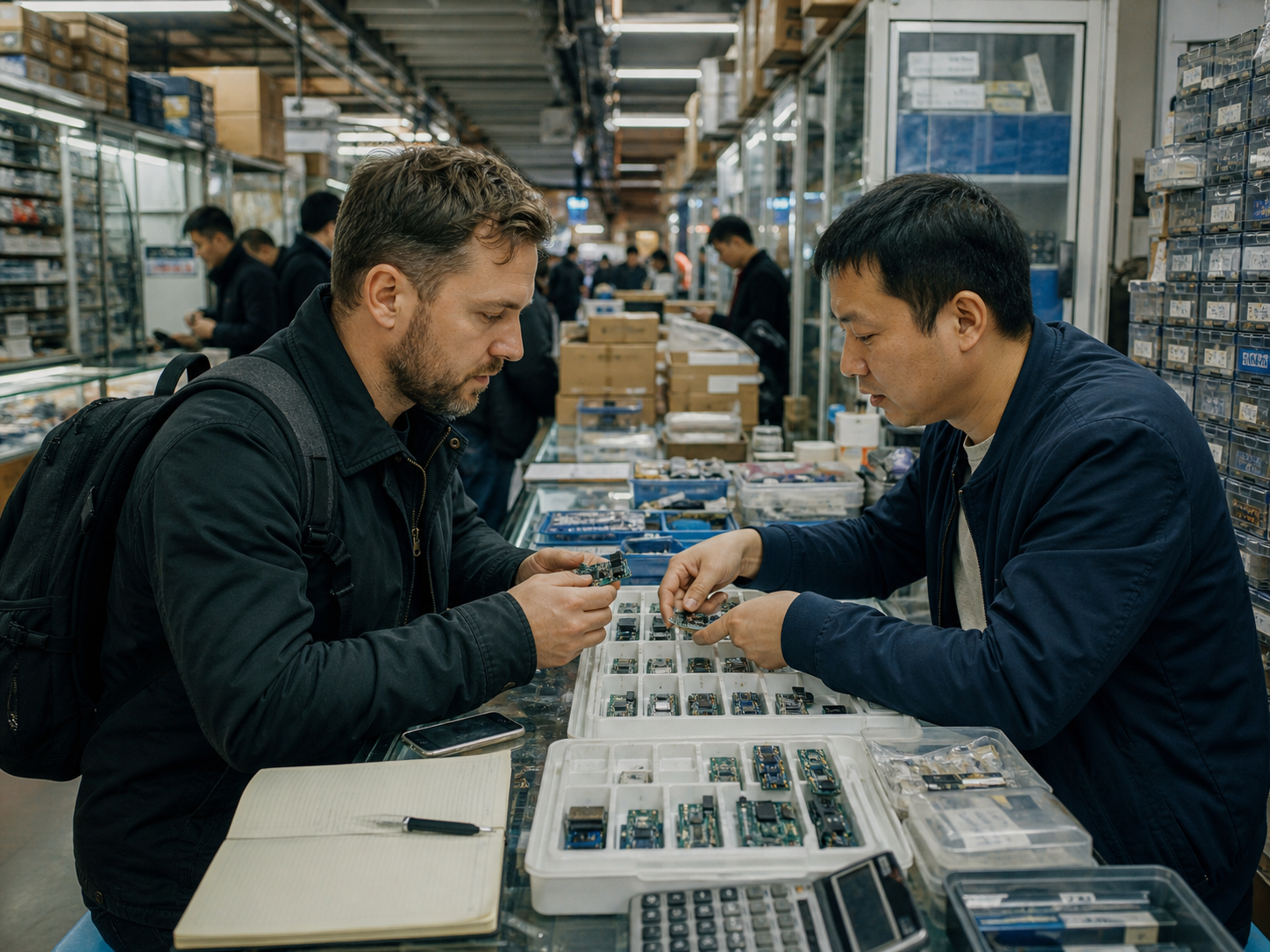
Huaqiangbei is one of the most tactically useful places in Shenzhen, and the most misunderstood. It is not a single market. It is a 1.5km² cluster of interconnected buildings, stalls, wholesalers, trading companies, component dealers, and repair supply chains. What exists here reflects what Chinese manufacturers buy and what the domestic aftermarket demands. Ignoring it before your first factory trip is a tactical loss.
Geography: buildings and what lives inside
Huaqiangbei breaks into five distinct zones. Understand the zone first; the stall choices inside become obvious.
| Building | Category density | Best for | Avoid for |
|---|---|---|---|
| SEG Plaza (华强电子世界) | Passives, ICs, modules, test gear | Completing a BOM in one morning | Production-volume pricing |
| Huaqiang Electronics World | Consumer parts, repair supply, modules | Reference-product teardowns | Custom design |
| Mingtong Digital City (明通) | Mobile SoCs, displays, batteries, flex | Smartphone-adjacent BOMs | Anything non-mobile |
| Yuanwang (远望) | Lab equipment, scopes, power supplies | Weekend prototype tooling | Volume parts |
| Tongtian (通天) | Connectors, cables, industrial switches | Cable-heavy BOMs | Crowded categories |
SEG Plaza, top 4 floors carry passives and small components; lower floors carry ICs and modules. Denser component density than anywhere else in Shenzhen outside industrial procurement yards. Expect 100+ stalls per floor selling capacitors, resistors, connectors, test equipment, and discrete semiconductors. Pricing: ¥0.001–¥50 per unit typical. Lead time: stock only (same-day or next-day minimum order). If your BOM includes 47µF/16V caps or 0.1µF ceramics, prices here set the market floor.
Huaqiang Electronics World, ground level to floor 3, consumer electronics parts, repair supply chains, used modules, knockoff comparison pieces. This is where phone repair shops stock parts, where people buy replacement SoCs, where you find reference designs for “how a Chinese OEM would solve this.” Fewer raw components; more assembled modules. Pricing: 20–40% below SEG Plaza per comparable function.
Mingtong Digital City, 8 stories, almost entirely mobile phone supply chain. SoCs, display modules, battery cells (loose), back covers, screens, flex cables, connectors. If your product has anything resembling a smartphone module, you’ll find 30+ active suppliers here. Margins are thin and lead times match casual repair-shop supply.
Yuanwang building, floors 3–4, lab equipment, oscilloscopes, power supplies, function generators. Useful if you need a ¥500 DC power supply to test a prototype over the weekend or to validate a reference schematic against actual silicon.
Tongtian market, passives, connectors, cable assemblies, industrial switches. Less glamorous; useful if you have a non-trivial connector or cable bill of materials. Smaller floors, less crowded, extreme catalog depth.
What Huaqiangbei is good for
- Completing a BOM for prototype or small-volume build (5–50 units) in one morning. Example: you have a PCB design; you need 200 capacitors in 10 values, 50 test points, 4 USB-C connectors, 2 antenna connectors, and a 16-pin DIP socket. A trader at SEG will bundle it in 2 hours.
- Comparing pricing against factory quotes. You got a sample BOM from a factory saying ¥2.50/unit for passives. Walk SEG, ask five stalls the same question, get five answers, find the market reality. Often you discover the factory is already sourcing from stalls here and marking up 25%.
- Understanding what a Chinese OEM would build. Find a reference product similar to what you’re trying to make. Tear it down. Walk Huaqiangbei. Discover which modules the OEM bought, which they built, which supplier category they chose. Your cost model just became real.
- Buying samples of modules, connectors, displays, or finished parts. A 10-unit MOQ is possible here; most factories’ minimum is 50–500.
- Market sensing. Which mobile chipsets are hot right now? What’s on clearance and why? What’s the typical bill of materials for a ¥500 retail consumer device? Walk the stalls. Watch what traders are moving.
- Identifying counterfeits and refurbished parts before you commit factory capital. Visit Huaqiangbei, buy 2 units for ¥20, test them, confirm. Then decide if the factory’s ¥0.50 cost basis is sustainable.
What Huaqiangbei is bad for
- Production-volume pricing. A stall selling ICs at ¥0.95/unit (25-unit MOQ) is not your production supplier. They are buying from the same source your factory will, at 2–3× higher per-unit cost.
- Authentic certifications. Many stalls sell parts labeled FCC/CE/RoHS. Some are real. Many are not. If certification is contractual or regulatory (medical, automotive, consumer safety), do not trust a stall certificate. Demand a third-party test report.
- Custom tooling or design. Stall owners do not design. They buy and resell. If you need a custom plastic enclosure or a bespoke mechanical solution, you need a factory, not Huaqiangbei.
- Consistency and traceability. If you need the same chip with the same date code from the same wafer batch every time, Huaqiangbei cannot deliver. They buy what’s available.
- Quality agreements. Stalls do not care about AQL 2.5 or IPC-A-610 standards. They sell as-is. If a chip fails in field, you have no recourse.
Pricing reality: how to bargain
Stall display prices are 30–60% above the actual cash market rate. This is not a scam; it is market structure. A stall keeper expects Chinese buyers to negotiate. Display price is an anchor; the real price emerges after conversation.
How bargaining works:
- Find the component. Note the stall display price: ¥10/unit (25-unit MOQ).
- Ask: “多少钱?” (How much?), they repeat ¥10.
- Ask: “能不能便宜点?” (Can it be cheaper?), they drop to ¥7–8.
- Counter: “我要100个,¥4?” (I want 100, ¥4 each?), they come back at ¥5.50 or ¥6.
- If you have a translator, let them negotiate the final 20%; your presence as a foreigner already signals you’re not price-sensitive enough to haggle for 30 minutes.
Expected final rate: 40–50% below display for 100+ unit orders. 60%+ if you cash-pay and visit weekly (relationship reduces their financing risk).
What to bring
- Sample of the component (or a photo on your phone). Bring a defective USB-C connector from your prototype; stall owners instantly understand what you need.
- Bill of materials, printed, English and Chinese side-by-side. Spend 30 minutes with a translator (or an AI) creating a one-page BOM in Chinese before your visit. Example: “100µF 16V electrolytic capacitor (电解电容器)”. 15 characters in Chinese prevents 20 minutes of miming.
- Target price written down (¥X/unit). Focuses the conversation on feasibility, not browsing.
- Target quantity. Stall owners have different paths for 10 vs. 100 vs. 1,000 units.
- Photos of your product or assembly. Context matters. If you’re sourcing a connector because you’re integrating it into a consumer device, they’ll suggest better options.
- Charging cable and 3–4 hours. You will walk slowly, text prices to your team, re-visit stalls three times as options clarify.
Counterfeit and refurbished risk
Huaqiangbei has real inventory and counterfeit inventory in the same building. You need to know what to ask and when to insist.
Common counterfeits:
- Decapped or relabeled chips. A stall buys dead boards, removes the chip, decaps it (sands off the original label), re-labels it with a new part number, and resells. Your test confirms it’s dead or flaky.
- Reflow or refurbished components. Boards that failed end-of-line test, were reballed, cleaned, and resold. Field failure rate: 5–15% higher than virgin stock.
- Cloned modules. A stall buys a reference design (say, a Bluetooth module), has a factory clone it for ¥0.50/unit, and sells it as the original for ¥2.50/unit.
How to ask (Chinese):
- “这是新的吗?还是翻新的?”, Is this new or refurbished?
- “有没有测试报告?”, Do you have a test report?
- “能不能给我看原始数据?”, Can you show me the original data sheet with date codes?
How to insist:
If a price is too good (IC at 80% below market rate), buy 2–3 units for testing, not 100. Test immediately. If 2 units pass, the batch is probably legitimate. If 1 fails, do not buy from that stall. For critical components (power supply ICs, microcontrollers, sensors), use Alibaba TradeAssurance or a sourcing partner who can request samples with third-party testing.
One day in Huaqiangbei: a practical schedule
- 10:00–10:45 Arrive at SEG Plaza. Locate the component section (typically floors 2–3). Identify 3–4 stalls with similar inventory. Get a bundled quote for your full BOM.
- 11:00–12:00 Walk Huaqiang Electronics World. Compare pricing on modules or finished products similar to your category. Buy a reference product (¥200–500 total) if a candidate exists.
- 12:00–13:00 Lunch at a stall-area restaurant (¥20–50/meal, good food).
- 13:00–14:30 Return to SEG. Revisit top 2–3 stalls from the morning. Negotiate final pricing. Ask about lead time for 100+ unit orders (“最快要几天?”).
- 14:30–15:30 Visit Yuanwang or Tongtian if your category is connector- or passive-heavy. If mobile/SoC, visit Mingtong instead.
- 15:30–17:00 Debrief. Walk back. Photograph all stall business cards. Text photos of quotes and reference products to your team. Update your sourcing notes.
Total time: 7 hours including meals and walking. Output: completed component BOM with pricing, reference products for teardown, 5–8 qualified supplier stalls for follow-up, and market pricing anchors.
Half-day, full-day, and three-day plans
Half-day (3 hours): BOM completion for one major subsystem, or finding reference products in one category. Walk SEG Plaza floors 2–3 and one category stall. Output: 20–40 component quotes, reference products, 2–3 stall cards.
Full-day (7 hours): Schedule above. Output: complete BOM pricing, teardown candidates, 8–12 qualified stalls, market rate anchors.
Three-day plan (15 hours): Day 1: SEG Plaza (all floors), Huaqiang Electronics World, reference research. Day 2: Mingtong or Tongtian deep category dive, plus Yuanwang for lab gear. Day 3: Revisit top 5 stalls, negotiate, build relationships, ask about wholesale onboarding or direct purchasing accounts. Output: complete BOM with negotiated pricing, 3–5 reference products torn down, 12–15 viable supplier stalls with volume pricing, informal sourcing partnerships initiated.
Trade shows that complement Huaqiangbei
- HKTDC Electronics Fair: Hong Kong, April (spring) and October (autumn). Mid-volume consumer electronics, modules, accessories. One hour from Shenzhen via the cross-border rail. Combine with a Huaqiangbei trip.
- Global Sources Electronics: Hong Kong, April and October, typically overlapping HKTDC. Heavier on mobile and consumer electronics; more aggressive on volume buyers.
- Canton Fair (China Import and Export Fair): Guangzhou, April–May and October–November, three phases. Phase 1 is electronics and home appliances. Three hours from Shenzhen by high-speed rail. Massive scale; bring stamina.
If you can time a Shenzhen trip to overlap with HKTDC Electronics, you get both the market floor (Huaqiangbei) and the qualified factory floor (HKTDC booths) in the same week.
First-time founder mistakes
A short list of recurring failures we see from founders walking Huaqiangbei alone:
- Treating display price as the real price. Every founder who walks in cold pays 30–60% over market. Fix: always ask “能不能便宜点?” at least twice before agreeing.
- Buying volume on day one. A 1,000-unit order from a stall you met an hour ago is a leap of faith. Always buy a 2–10 unit sample first, test in your hotel that evening, return next day to negotiate volume if samples passed.
- Mistaking traders for factories. Most stalls in SEG and Mingtong are traders. The factory is two hours north in Dongguan or Huizhou. Ask “你们自己生产吗?还是代理?” (Do you manufacture, or are you an agent?). The answer matters for pricing, lead time, and IP.
- No photo discipline. You see 80 stalls, you remember 5. Photograph every business card, every quoted price (write it on paper next to the part), every reference product. Drop them in a shared folder before you leave the building.
- Ignoring lunch. Skipping lunch on a 7-hour walk in 32°C summer humidity is how you end up making bad sourcing decisions at 4pm. Eat at 12. The stalls close for lunch anyway.
- Trusting “FCC certified” labels. A label is paint. Ask for the test report PDF, by stall, by part number, by date code. If they can’t produce one in 5 minutes, the cert is not real.
- Walking the wrong building for your category. If you’re sourcing a Bluetooth audio module and you spend two hours in Tongtian (connectors and cables), you wasted two hours. Read the geography table above before you start.
After Huaqiangbei: what to do with the data
Walking the market is only half the work. The other half is converting what you saw into a usable sourcing plan.
That evening (or on the high-speed rail back to Hong Kong):
- Triage your stall cards. Three piles: A, quoted in your price range with reasonable lead time; B, quoted high but had the right part; C, drop.
- Spreadsheet your BOM. Columns: part, target price, stall A quote, stall B quote, stall C quote, supplier name (if disclosed), WeChat ID, photo of card. Two hours of typing saves 20 hours of “wait, who said what?” later.
- Reverse-engineer the supply chain. For each module you bought as a reference product, look up the SoC and the major ICs (you can read part numbers off the silicon). Search those on LCSC, Mouser, and Digikey. You now have a price floor, what the chip costs at quantity in the licit supply chain. Compare to what the trader quoted.
- WeChat the top 5 stalls within 24 hours. “Hello, I visited your stall at SEG, floor 3, today. I’m interested in [part]. Can you send a formal quote for 1,000 units, with payment terms and lead time?” A response within 48 hours = engaged supplier. No response = move on.
The week after:
- Cross-reference what you saw at Huaqiangbei with what your factory quoted. If the factory is paying ¥0.85 for a chip you saw at ¥0.95 retail, that’s a healthy relationship. If they’re paying ¥1.50, you have a conversation to have.
- Order Alibaba samples for the top 2 modules you couldn’t find locally. Compare 14 days later.
- Build a one-page sourcing memo for your team or investors: “Walked Huaqiangbei [date], confirmed BOM cost at ¥X/unit, identified Y supplier candidates for follow-up, market signal on Z.” Investors love this memo.
When to use us
If you’ve read this far and the schedule still feels overwhelming, or you’d rather not spend three days alone in a market where 80% of signage is in characters you can’t read, that’s what our sourcing desk and hardware founder tour exist for. We run Huaqiangbei weekly, know which stalls have moved, which traders quote fairly, and which buildings have been emptied for renovation since the last guide on the internet was written. For investors travelling with a portfolio company, our investor delegation bundles half a day in Huaqiangbei with a curated factory visit in Bao’an or Dongguan.
Last reviewed: 2026-05-23.
Frequently asked questions
Do I need to speak Mandarin to walk Huaqiangbei?
No, but you'll spend 3–4x longer without a translator. A good translator costs ¥200–400/day. Spending 8 hours with a translator is faster and cheaper than spending 2–3 days alone. Minimum survival phrases: 你有没有…? (Do you have…?), 多少钱?(How much?), 能不能便宜点?(Can it be cheaper?), 能送样吗?(Can you send a sample?).
Are these 'real' prices, or will they change at my factory?
Huaqiangbei prices tell you the market floor for individual components, not what a factory will quote. A factory buying 50,000 capacitors gets 30–50% discounts that stalls do not. Use stall prices to validate that your factory's cost assumptions are in the ballpark; do not use them as your final cost model.
Can I buy 10,000 units of something directly from a Huaqiangbei stall?
Technically yes, but tactically no. A stall will source from a factory, take 5–8 days, and mark up 15–25%. Call the factory directly, you get better pricing, longer payment terms, and a quality agreement. Ask the stall: 你的供应商是谁?(Who is your supplier?) Some will tell you.
What if a stall is selling counterfeit parts?
Small counterfeit operations exist alongside legitimate traders. Buy 2–3 samples first. Test immediately. If parts fail or look cloned, do not return. If parts pass, order in bulk. For critical components, request a third-party test report (SGS, Intertek, Bureau Veritas). Cost: ¥500–2,000 per report.
Should I hire a sourcing partner or walk Huaqiangbei myself?
Walk it yourself if your BOM is simple (<50 unique parts), timeline is flexible, and you have 3–5 days in Shenzhen. Hire a partner if your BOM is complex (>100 parts), you need supplier qualification and factory visits, your timeline is under 3 weeks, or you need ongoing sourcing relationships.
How much cash should I bring?
Most stalls accept WeChat Pay and Alipay; few accept cards. Bring ¥2,000–5,000 in physical cash for sample buys and small purchases, and make sure your WeChat/Alipay daily limit is high enough for ¥10,000+ orders. Set this up before your trip. Adding a Chinese bank link from abroad is painful.