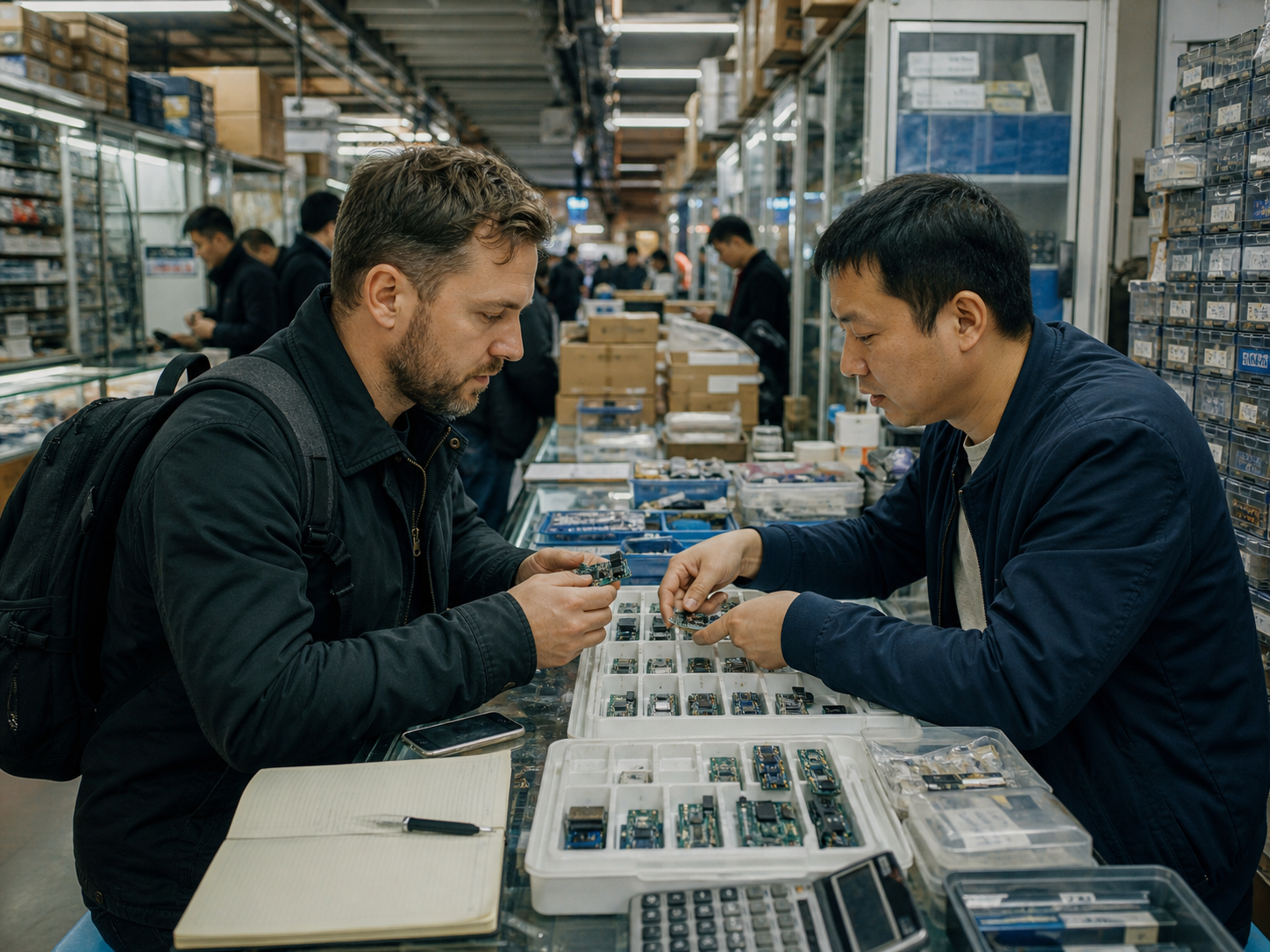
Injection moulding is where most hardware products meet their plastics. The Pearl River Delta, specifically Dongguan and Bao’an, runs the world’s deepest injection moulding ecosystem, from prototype-grade aluminium tools through hardened production steel with 16+ cavities. Tool makers, mould bases, raw resin distributors, and finishing services (pad print, hot stamp, in-mould decoration) all sit inside a 30km radius. The practical result: from a final CAD file you can be holding T0 samples in 3–6 weeks and shipping 10,000 production parts inside 10–12 weeks.
What this covers
This page covers thermoplastic injection moulding: tool design and manufacture, sample shots, production runs, common materials (ABS, PC, PC/ABS, PA6/PA66, TPU, PP, POM), and secondary operations (in-mould decoration, two-shot, overmoulding, pad printing, hot stamping, ultrasonic welding). It does not cover blow moulding (separate sub-cluster for bottles and hollow containers), rotational moulding, thermoforming, or silicone moulding, silicone has its own page under prototyping for low-volume work.
What Shenzhen and the PRD are uniquely good at
- Tooling depth. Hundreds of mould-making shops sit in Dongguan’s Changping, Houjie, and Chang’an towns, with secondary clusters in Bao’an. The depth of EDM, CNC milling, and polishing skill is unmatched globally.
- Material availability. Every major engineering resin, and most exotic ones, is in stock with Pearl River Delta distributors. Colour matching to Pantone is a same-week service.
- Secondary integration. Pad printing, hot stamping, ultrasonic welding, assembly, and packing happen in the same factory complex or within a 15-minute drive.
- Cost structure. A production mould that costs USD 30,000–60,000 in the US or EU costs ¥40,000–120,000 (USD 5,500–16,700) here for equivalent quality from a tier-1 mainland mould maker.
Sub-categories
| Sub-category | Typical use | Cavity / runner | Cluster |
|---|---|---|---|
| Prototype tool | First 100–500 parts, design validation | Single cavity, cold runner, aluminium or P20 | Bao’an + Dongguan |
| Production tool, single cavity | Low volume, large parts | Single cavity, cold or hot runner, 718H/S136 | Dongguan |
| Production tool, multi-cavity | Medium-high volume small parts | 2/4/8/16 cavity, hot runner | Dongguan |
| Family mould | Different parts sharing one tool | Multiple cavities for related geometries | Dongguan |
| Two-shot / overmould | Soft-grip TPU on rigid substrate | Rotating platen, two materials | Dongguan specialists |
| In-mould decoration (IMD) | Cosmetic films integrated into moulding | Pre-printed film loaded before injection | Bao’an specialists |
| Insert moulding | Metal inserts moulded into plastic | Single cavity with insert loading | Bao’an + Dongguan |
MOQs and lead times
| Stage | MOQ | Lead time |
|---|---|---|
| Prototype tool build | n/a (one tool) | 3–4 weeks |
| Production tool build (single cavity) | n/a | 4–6 weeks |
| Production tool build (multi-cavity, hot runner) | n/a | 6–10 weeks |
| T0 / T1 / T2 sample shots | 30–100 parts each | 1–2 weeks per iteration |
| Production run | 500–5,000 per cavity (per order, not minimum lifetime) | 2–4 weeks |
| Colour change between batches | n/a | +1 day for cold runner, +2–3 days for hot runner |
| Secondary printing / decoration | Same MOQ as moulding | +1–2 weeks |
Price bands
All prices at stated quantity, ex-works Pearl River Delta, May 2026. USD conversions at ¥7.2.
Tooling
| Mould type | Reference part | Tooling cost |
|---|---|---|
| Prototype aluminium, single cavity | 100×60×20mm, simple geometry | ¥8,000–18,000 (USD 1,100–2,500) |
| Production P20, single cavity | Same | ¥18,000–40,000 (USD 2,500–5,550) |
| Production 718H, single cavity | Same | ¥30,000–60,000 (USD 4,150–8,300) |
| Production S136 hardened, single cavity | Cosmetic transparent part | ¥50,000–90,000 (USD 6,900–12,500) |
| Production 4-cavity, hot runner | Same reference part | ¥80,000–160,000 (USD 11,100–22,200) |
| Production 8-cavity, hot runner | Small part, 30×20×5mm | ¥120,000–250,000 (USD 16,700–34,700) |
| Two-shot overmould tool | TPU grip on ABS body | ¥80,000–180,000 (USD 11,100–25,000) |
Per-shot pricing (single cavity, palm-sized part)
| Material | 1,000 units | 5,000 units | 50,000 units |
|---|---|---|---|
| ABS | ¥1.50–4 (USD 0.20–0.55) | ¥0.80–2.50 (USD 0.11–0.35) | ¥0.50–1.50 (USD 0.07–0.20) |
| PC | ¥2–5 (USD 0.28–0.70) | ¥1.20–3 (USD 0.17–0.42) | ¥0.80–2 (USD 0.11–0.28) |
| PC/ABS | ¥1.80–4.50 (USD 0.25–0.62) | ¥1–3 (USD 0.14–0.42) | ¥0.70–1.80 (USD 0.10–0.25) |
| PA66 (glass-filled) | ¥3–7 (USD 0.42–0.97) | ¥1.80–4 (USD 0.25–0.55) | ¥1.20–2.80 (USD 0.17–0.39) |
| TPU | ¥3–8 (USD 0.42–1.11) | ¥2–5 (USD 0.28–0.70) | ¥1.30–3.50 (USD 0.18–0.49) |
| PP | ¥1–3 (USD 0.14–0.42) | ¥0.60–1.80 (USD 0.08–0.25) | ¥0.40–1.20 (USD 0.06–0.17) |
| POM | ¥2.50–6 (USD 0.35–0.83) | ¥1.50–3.80 (USD 0.21–0.53) | ¥1–2.50 (USD 0.14–0.35) |
| In-mould decoration uplift | +¥1–3 per part | +¥0.80–2 | +¥0.50–1.30 |
| Two-shot uplift | +30–60% on base | +30–60% | +25–50% |
Specs to lock down
- Mould steel: P20 (under 200k shots), 718H (under 500k), S136 (cosmetic, transparent, or corrosion), H13 hardened (over 1M shots)
- Cavity count, with explicit life requirement per cavity
- Runner system: cold runner (lower cost, runner waste) or hot runner (more upfront, better cycle time)
- Gate type: edge gate, sub-gate, hot-tip, valve gate, with location marked on the drawing
- Cooling layout: standard channels or conformal cooling (3D-printed inserts)
- SPI surface finish (A1 mirror, A2/A3 polished, B1/B2 paper-finished, C1/C2 stone-rubbed, D1/D2/D3 bead-blasted texture)
- Material grade with specific MFR (melt flow rate) and any UV / flame / colour requirements
- Draft angles (1° minimum, 3° preferred), wall thickness uniformity, rib-to-wall ratios
- Tolerances per DIN 16742 or customer-specific
- Ejector pin locations called out, away from cosmetic surfaces
- Secondary operations: printing, ultrasonic welding, assembly, packing
Process
- DFM review of CAD against moulding constraints, wall thickness, draft, undercuts, sink risks.
- Mould design (2D drawing + 3D model) by tier-1 mainland mould maker, with cavity / runner / cooling layout.
- Customer sign-off on mould design before steel is cut.
- Tool build: rough machining, EDM detail, polishing, fitting, assembly. 3–6 weeks for a typical production tool.
- T0 sample shots: first 30–50 parts, sent with mould-flow analysis and defect notes.
- T1 corrections: gate, vent, cooling adjustments based on T0 results.
- T2 production-quality samples for first-article inspection.
- Production run, with first piece of every shift inspected for shorts, flash, sink, warp.
- Final 100% visual + AQL dimensional sampling.
- Mould storage and maintenance schedule for repeat orders.
QC specifics
- First-article inspection (FAI) report on T2 samples, with each critical dimension measured.
- Cosmetic inspection against an approved master sample (the “golden sample”) under D65 lighting.
- Sink and warp measurement on samples taken at start, middle, and end of each production shift.
- Drop test, environmental test, or functional test as defined by end-application, IPX rating, fall from 1.2m onto concrete, 200-hour UV exposure for outdoor parts.
- Material verification: melt-flow test on incoming resin, especially for colour-matched or recycled blends.
- Mould condition photos every 50,000 shots: cavity wear, gate erosion, vent buildup.
What goes wrong
- Sink marks on thick sections opposite ribs. Mitigation: keep rib thickness ≤60% of nominal wall, design coring on the back of thick bosses, increase pack pressure rather than over-thickening.
- Warp from uneven cooling. Mitigation: design conformal cooling channels into the mould, balance gate locations, allow longer cooling time on first parts.
- Short shots or flash on T0. Mitigation: standard for T0, fix gates, vents, parting line on T1. Reject any T0 that’s claimed to be “production ready”.
- Cavity-to-cavity variation in multi-cavity tools. Mitigation: demand cavity-numbered samples from every cavity at FAI, dimension each separately, require runner balancing.
- Material drift between batches. Mitigation: lock resin grade and MFR in writing, demand resin certificates per batch, spot-test melt flow on incoming.
- Pad print or hot stamp misalignment. Mitigation: design locating features into the part for the printing jig, approve a golden sample for the printer, AQL inspect cosmetics.
- Mould wear faster than promised. Mitigation: written mould life guarantee tied to shot count, inspect every 50,000 shots, demand cavity insert replaceability.
Certifications
- RoHS / REACH declarations on resin and any colourants.
- FDA / LFGB for food-contact grades, specify upfront, material cost premium of 10–30%.
- USP Class VI for medical-grade plastics, narrow material list, longer lead time.
- UL 94 V-0 or V-1 flame ratings for electronics enclosures.
- PAHs test (Polycyclic Aromatic Hydrocarbons) for consumer goods entering the EU.
- Phthalate testing for children’s products (CPSIA in the US, REACH in the EU).
- ISO 9001 is standard for any tier-1 supplier; ISO 14001 for environmental management; ISO 13485 for medical device moulding.
Trade shows
- Chinaplas (Shanghai or Shenzhen, alternating, April), the dominant plastics trade show in Asia; resin, machinery, moulders, finishers.
- HKTDC Electronics Fair (April, October), many enclosure moulders exhibit alongside their electronics customers.
- Canton Fair (April, October), broad and useful for cross-shopping moulders against other component suppliers.
- ELEXCON (Shenzhen, late summer), domestic ecosystem; useful for finding moulders servicing local electronics OEMs.
- DMP (Dongguan International Mould and Metalworking Exhibition) (Dongguan, November), the tooling-side show, deep on mould makers and equipment.
When to use us
Injection moulding is the category where DFM-stage mistakes are most expensive to fix, by the time you’ve cut steel, the cost of a redesign is 10–50× the cost of getting it right the first time. The sourcing desk handles tier-1 mould maker shortlisting, DFM review, mould design sign-off, and T0/T1/T2 review remotely. The hardware founder tour is the in-person version, walking Dongguan tool rooms, watching steel being cut, and sitting in on sample-shot reviews so the production tool ships with no surprises.
Last reviewed: 23 May 2026.
Frequently asked questions
How do I know if I need a single-cavity or multi-cavity mould?
Single-cavity is right for low-volume products (under ~50,000/year), prototypes, or when part-to-part consistency is more important than throughput. Multi-cavity (2, 4, 8, 16 cavities in one tool) is for higher volume, the mould costs 1.5–3× more but per-shot cost drops proportionally. Rule of thumb in the Pearl River Delta: under 20,000 lifetime parts go single-cavity, 20,000–100,000 go 2- or 4-cavity, above that go 8+ cavities. Discuss expected annual volume with a tier-1 mainland mould maker before committing, overspending on cavities is one of the most common hardware-founder mistakes.
What's the difference between T0, T1, and T2 sample shots?
T0 is the first shot off the new mould, usually has flash, short shots, warp, and obvious defects. T1 is the second iteration after the mould maker corrects the obvious problems (gate location, venting, cooling). T2 should be production-quality parts ready for first-article inspection. Budget for at least T0 + T1 + T2 in your timeline; demanding 'production parts on T0' is unrealistic and pushes the mould maker into shortcuts that haunt you later.
Hot runner vs cold runner, which should I pick?
Cold runner moulds are cheaper to build (¥10,000–30,000 less), simpler to maintain, and tolerate colour changes well. The runner material is waste each shot, a few grams per part. Hot runner moulds eliminate runner waste, give better surface finish near gates, and run faster cycle times, but they cost more upfront and need careful temperature management. Pick cold runner for low-volume, multi-colour, or material-change runs. Pick hot runner for high-volume single-colour production where material savings amortise the tooling premium within 1–2 years.
Why does my mould cost vary 4× between Shenzhen suppliers?
Mould steel choice (P20 vs 718H vs S136 vs hardened H13), cavity count, runner type, cooling channel complexity, slide and lifter count, and surface finish are all independent cost drivers. A 'simple' single-cavity P20 mould for a 100×60×20mm part costs ¥15,000–25,000 at a tier-1 mainland mould maker. The same geometry in S136 stainless with hot runner, four slides, and SPI A2 finish costs ¥80,000–120,000. Both are 'right' answers; the question is what your application needs. Quote against an identical spec sheet, not vague descriptions.
How do I avoid getting a mould that wears out before the order is finished?
Specify mould life in writing: '500,000 shots minimum, with cavity inserts replaceable.' Lock the mould steel grade, P20 is fine for under 200,000 shots, 718H for 500,000, S136 hardened for 1,000,000+. Demand a maintenance schedule and a written mould life guarantee. Inspect the mould every 50,000 shots: cavity wear, gate erosion, vent buildup. Tier-1 mould makers will happily provide the guarantee; budget shops will dodge it. The price difference reflects exactly that risk.
What's a realistic timeline from final CAD to first production parts?
For a moderately complex part, palm-sized, one slide, single cavity, ABS or PC, budget 6–10 weeks total: 1 week for DFM and quoting, 3–5 weeks for tool build, 1–2 weeks for T0/T1/T2 iterations and approval, 1–2 weeks for first production batch. Multi-cavity production tools take 6–10 weeks for tool build alone. Anyone quoting 'first parts in three weeks' for a new production tool is either using an existing mould base, simplifying somewhere, or about to disappoint you.