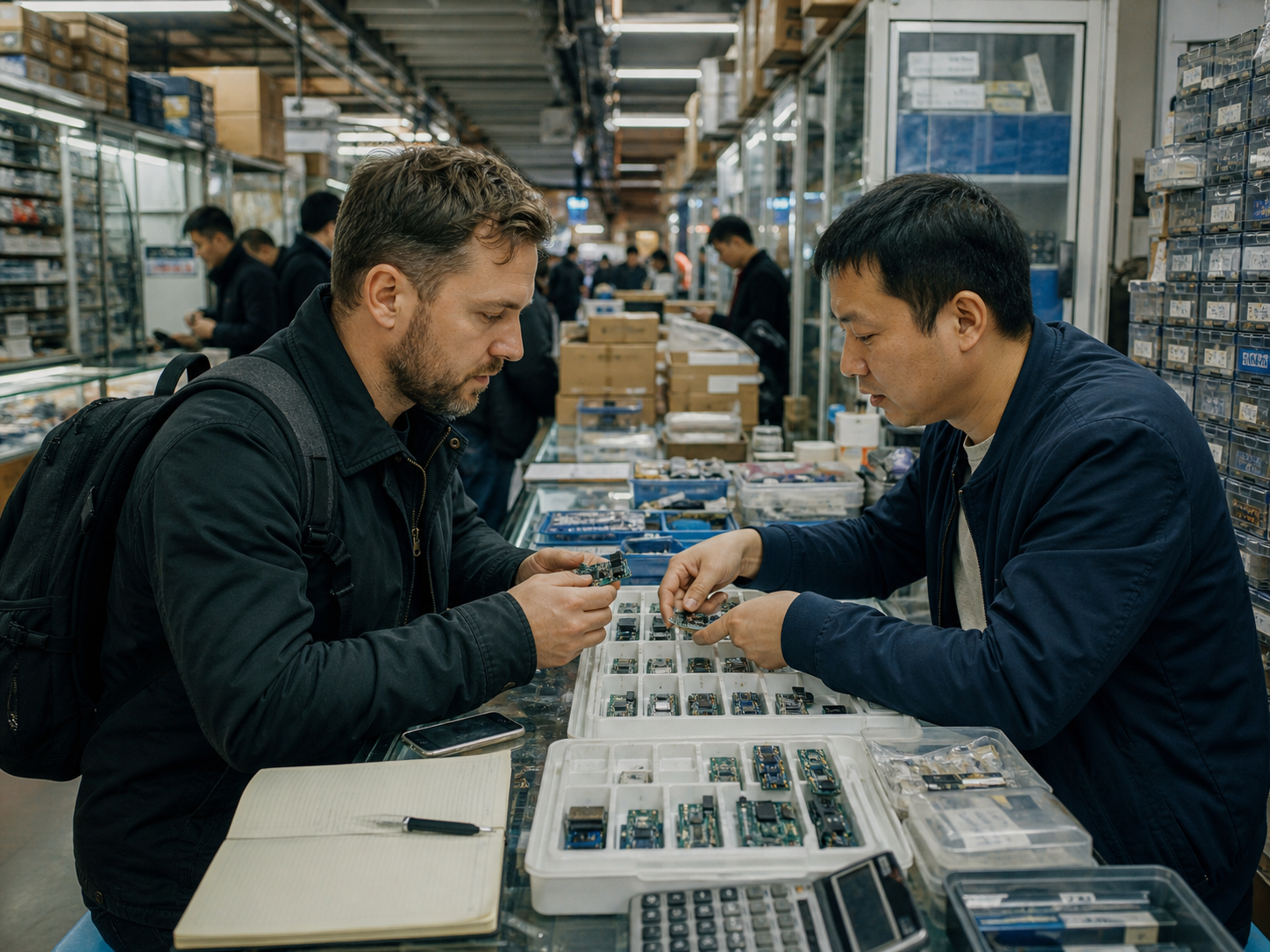
IoT and smart home hardware is the category where Shenzhen most clearly out-competes every other geography. The ecosystem of pre-certified wireless modules, ESP32, Nordic, Realtek-based, combined with mature sensor module suppliers, deep antenna design capability, and battery-pack integration makes connected device development faster and cheaper here than anywhere else. The trap is factory cloud lock-in: take the integration cost seriously and own your firmware, backend, and update path, and the supply chain advantages are decisive.
What this covers
This page covers IoT and smart home hardware: wireless modules (BLE, Wi-Fi, Zigbee, Thread, Matter), microcontrollers, sensor modules (environmental, motion, presence, energy), connected-product PCBA, antenna design and tuning, firmware development support, and certification logistics. It does not cover backend cloud services, mobile app development, or AI/ML model design, those are software disciplines with their own supplier base, often outside Shenzhen.
What Shenzhen and the PRD are uniquely good at
- Pre-certified module density. Hundreds of wireless modules with FCC, CE, KC, TELEC, IC pre-certification are stock items at LCSC and authorised distributors. Modular approval on end products is a paperwork exercise, not a re-test.
- Reference designs. Most chip families have multiple Pearl River Delta SMT line suppliers shipping reference boards with example firmware, schematic, layout, and BOM. Iteration cycles measured in days.
- Antenna design capability. Bao’an antenna design houses can tune a PCB or chip antenna for your end-product enclosure in 2–4 weeks, with anechoic-chamber measurement included.
- Sensor module breadth. Off-the-shelf modules for almost any environmental or motion sensor exist with documented APIs, often with reference firmware for ESP32 or Nordic SDKs.
- Cost-quality positioning. A BLE-enabled smart device that costs USD 8–12 BOM in the US can be done at USD 4–6 BOM here without sacrificing certification or quality.
Sub-categories
| Sub-category | Examples | Cluster |
|---|---|---|
| BLE modules | Nordic nRF52/53/54, ESP32-C3, Realtek RTL8762 | Bao’an + Longgang |
| Wi-Fi modules | ESP32 family, Realtek RTL8720, MediaTek MT7682 | Bao’an + Longgang |
| Zigbee / Thread / Matter modules | Silicon Labs, Espressif C6 / H2, TI CC26xx | Bao’an + Longgang |
| LoRa / LPWAN modules | Semtech SX126x-based, Heltec, Ai-Thinker | Bao’an |
| LTE / NB-IoT / Cat-M modules | Quectel, Fibocom, SIMCom | Longgang |
| MCUs (general) | STM32, ESP32 (also a Wi-Fi/BLE chip), Nordic, RP2040 | Authorised distributors |
| Sensor modules | BME680, BMI270, VL53L5CX, MLX90640, PIR, mmWave | Bao’an |
| Camera modules (for IoT cameras) | OV5640, IMX415, Sony 1/2.7” stock | Bao’an specialists |
| Antenna design | PCB, ceramic chip, external; tuning + chamber | Bao’an antenna houses |
| IoT PCBA (full assembly) | All of the above on customer PCB | Pearl River Delta SMT lines |
MOQs and lead times
| Item | MOQ | Lead time |
|---|---|---|
| Stock BLE module | 500 (cut tape lower) | 1–3 weeks |
| Stock Wi-Fi + BLE module (ESP32 family) | 500 | 1–3 weeks |
| Stock Zigbee / Thread / Matter module | 500–1,000 | 2–4 weeks |
| Customised module with your firmware loaded | 1,000 | 4–6 weeks |
| Customised module with antenna tuning | 1,000–2,000 | 6–10 weeks |
| Full custom PCB module | 2,000–5,000 | 8–14 weeks (incl certification) |
| Sensor module (off-the-shelf) | 100–500 | 1–3 weeks |
| LTE / NB-IoT module | 500–1,000 | 2–4 weeks |
| Antenna design + tune | 1,000 (after design) | 3–4 weeks design |
| Modular FCC/CE approval (using pre-cert module) | n/a | 3–6 weeks |
| Full FCC/CE on custom module | n/a | 6–12 weeks |
Price bands
All prices at the stated quantity, ex-works Pearl River Delta, May 2026. USD conversions at ¥7.2.
| Item | 1,000 units | 10,000 units |
|---|---|---|
| ESP32-C3 module (Wi-Fi 4 + BLE 5) | ¥12–20 (USD 1.67–2.78) | ¥9–15 (USD 1.25–2.08) |
| ESP32-S3 module (Wi-Fi 4 + BLE 5, dual core) | ¥18–32 (USD 2.50–4.45) | ¥14–25 (USD 1.94–3.47) |
| ESP32-C6 module (Wi-Fi 6 + BLE 5 + Thread) | ¥22–40 (USD 3.05–5.55) | ¥17–32 (USD 2.36–4.45) |
| Nordic nRF52840 module (BLE 5, Thread) | ¥28–48 (USD 3.89–6.67) | ¥22–38 (USD 3.05–5.28) |
| Nordic nRF54L module (BLE 5.4, low power) | ¥38–70 (USD 5.28–9.72) | ¥30–55 (USD 4.17–7.65) |
| Realtek BLE module (cost-optimised) | ¥9–16 (USD 1.25–2.22) | ¥7–13 (USD 0.97–1.81) |
| Silicon Labs Zigbee/Thread/Matter module | ¥35–60 (USD 4.86–8.33) | ¥27–48 (USD 3.75–6.67) |
| LoRa SX1262-based module | ¥22–40 (USD 3.05–5.55) | ¥17–32 (USD 2.36–4.45) |
| Quectel NB-IoT module | ¥45–80 (USD 6.25–11.10) | ¥35–65 (USD 4.86–9.03) |
| Quectel LTE Cat-1 module | ¥80–150 (USD 11.10–20.80) | ¥65–120 (USD 9.03–16.70) |
| BME680 environmental sensor module | ¥35–60 (USD 4.86–8.33) | ¥28–48 (USD 3.89–6.67) |
| PIR motion module | ¥6–14 (USD 0.83–1.94) | ¥4.50–11 (USD 0.62–1.53) |
| mmWave presence sensor module | ¥30–60 (USD 4.17–8.33) | ¥22–48 (USD 3.05–6.67) |
| Antenna tuning + chamber report | ¥18,000–45,000 NRE | amortised |
| FCC modular approval | ¥15,000–25,000 one-time | amortised |
| CE / RED modular approval | ¥18,000–35,000 one-time | amortised |
| Matter certification | ¥40,000–80,000 + annual fees | amortised |
Specs to lock down
- Radio specification: protocol(s), output power, sensitivity, supported features
- Antenna: PCB, ceramic chip, external; tuning measured in your end-product enclosure
- MCU: flash size (with OTA partition allowance), RAM, peripherals
- Power profile: deep-sleep current, active current, transmit current peak
- Firmware: yours or factory’s; OTA path (under your control); signing keys (yours)
- Backend: yours, period, explicit refusal of any factory cloud lock-in
- Pre-certification status of module (FCC, CE, KC, TELEC, IC)
- End-product certification scope (modular approval if module is pre-cert)
- Mechanical: module dimensions, connector or solderable
- Quality grade: commercial vs industrial temp range
- Production traceability: lot codes, firmware version per lot
Process
- System architecture: radios, MCU, sensors, power budget, certification scope.
- Module selection from pre-certified options where possible; custom only if no fit.
- Reference-design build using stock module on standard dev kit, validate firmware approach.
- Custom PCB design integrating module, sensors, power management, antenna.
- Antenna tuning in actual end-product enclosure, chamber measurement at a Bao’an antenna house.
- Firmware development with OTA path under your infrastructure.
- Pilot build with full production materials and certification-equivalent samples.
- Pre-compliance EMC testing (1–2 day chamber rental) before formal cert.
- Formal FCC / CE / other certification, modular if possible.
- Production run with first-piece functional test, OTA-update verification, traceability per lot.
QC specifics
- Module incoming: visual, date code, lot code, firmware version sample-test.
- Antenna verification on every PCBA design change: VSWR measurement, transmit power, range test.
- Firmware OTA verification on every batch: load production firmware, then OTA to current, verify all features.
- RF performance on production: spot transmit power and frequency on a sample plan (5 per 100 typical).
- Deep-sleep current measurement on every unit for battery-powered devices.
- Functional test fixture covering all radios, sensors, and I/O, run-time 30–60 seconds per unit.
What goes wrong
- Factory cloud lock-in. Mitigation: refuse factory cloud; spec your backend; verify every API call points to your server during pilot.
- Antenna performance degrades in production enclosure. Mitigation: chamber measurement in actual enclosure (not bare PCB); tune layout before tooling locked.
- OTA failures bricking units. Mitigation: A/B partition layout with automatic rollback; signed firmware; pre-launch OTA stress test (1,000 cycles).
- Pre-cert module substituted silently. Mitigation: lock module part number and FCC ID; verify FCC ID on incoming; require manufacturer cert per batch.
- Sleep current drifts in production. Mitigation: every-unit sleep current test on production line; reject units >120% of spec.
- MCU flash insufficient for OTA partition. Mitigation: budget 50% margin on flash from day one; A/B partition is non-negotiable; if cost-driven smaller flash, plan for external SPI flash.
- Firmware version drift between batches. Mitigation: lock firmware version per production order; verify version on sample-test in incoming; lot-level traceability.
Certifications
- FCC Part 15 (US), required for any intentional radiator. Use pre-certified modules for modular approval (faster, cheaper).
- CE / RED (Europe), radio equipment directive. Modular approval available.
- UKCA (UK post-Brexit), increasingly required separately from CE.
- KC (Korea), radio approval; ~¥15,000–25,000.
- TELEC / MIC (Japan), radio approval; ~¥18,000–30,000.
- IC (Canada), radio approval; often co-tested with FCC.
- Matter certification (CSA Alliance), for Matter-branded devices; annual membership + per-product certification fee.
- Apple HomeKit (MFi), separate Apple program with NDA, chip-level requirements; budget several months for approval.
- Google Home / Alexa, software integration via Cloud-to-Cloud or Matter; less hardware-side, more software work.
- RoHS / REACH / WEEE, standard for any device sold in EU.
Trade shows
- HKTDC Electronics Fair (April, October), IoT and smart home modules occupy multiple halls.
- ELEXCON (Shenzhen, late summer), strong on IoT chips and modules from Chinese suppliers.
- Bluetooth World Asia / Wireless World Asia (Shenzhen, varies), narrowly focused on wireless protocols.
- Smart Home Summit (Shenzhen, varies), smart home ecosystem, including Matter and Tuya-adjacent suppliers.
- CES (Las Vegas, January), not in China, but most Pearl River Delta IoT suppliers exhibit; useful for first contact before Shenzhen visits.
- High-Tech Fair (CHTF) (Shenzhen, November), broader, useful for emerging IoT applications.
When to use us
IoT and smart home is the category where the difference between “ship in 3 months at USD 5 BOM” and “ship in 12 months at USD 9 BOM” comes down to picking the right module, owning your firmware/backend, and routing certification through modular approval. The sourcing desk handles module selection, antenna-house introductions, certification logistics, and factory-cloud refusal negotiation. The hardware founder tour is the in-person version, walking module suppliers in Bao’an, sitting in on antenna tuning chamber sessions, and meeting the certification labs that will issue your modular approval.
Last reviewed: 23 May 2026.
Frequently asked questions
BLE, Wi-Fi, Zigbee, or Matter, which radio for my product?
BLE for low-power local pairing (wearables, sensors, beacons, peripherals): cheap, ubiquitous on phones, no router needed. Wi-Fi for high-bandwidth or always-on connectivity (cameras, smart speakers, anything streaming): higher power, needs router. Zigbee or Z-Wave for mesh-networked smart home devices in dense deployments (light bulbs, switches, sensors at scale): low power, needs a hub, mature ecosystem. Matter sits on top of Wi-Fi or Thread and is the emerging standard for cross-vendor smart home, choose Matter if you want compatibility with Apple, Google, Amazon ecosystems out of the box. Many devices ship with multiple radios (BLE for setup, Wi-Fi or Thread for normal operation).
ESP32, Nordic, or Realtek, which chip family?
ESP32 (Espressif) is the cost king and the broadest community: Wi-Fi + BLE, lots of variants (ESP32-S3, ESP32-C3, ESP32-C6 with Thread/Matter), ¥12–25 per module, vast example code. Nordic (nRF52, nRF53, nRF54) is the premium BLE choice: best radio performance, lowest power, excellent SDK, strong support, ¥18–35 per module, worth it for battery-powered devices where power matters. Realtek is the budget Wi-Fi option: lower cost than Espressif on plain Wi-Fi, less community, less feature-rich. Default to ESP32 for general IoT; Nordic for serious battery products; Realtek when you need pure Wi-Fi at lowest cost.
What's wrong with using the factory's cloud platform?
Three problems. First, you lose control of the customer relationship, onboarding, support, account data, and billing all sit with the factory. Second, you cannot easily switch factories without orphaning users or migrating them through a painful re-onboarding. Third, factory clouds typically have poor reliability, no SLA, limited API access, and unclear data ownership. The right pattern is: factory provides the hardware and firmware that talks to *your* backend, with firmware OTA update path under your control. Factories will quote 30–60% lower pricing if you accept their cloud, that discount is almost never worth the long-term cost.
How do I handle firmware OTA updates?
Spec OTA from day one. Lock the bootloader format, signing keys, and update server protocol before tooling. Run the OTA update path through *your* infrastructure, not the chip vendor's cloud or the factory's. Allocate at least 25% of flash to A/B partition layout so failed updates can roll back. Test OTA across all field conditions (poor RF, intermittent connectivity, partial power). For BLE-only products without backhaul, OTA via the companion mobile app is the standard pattern; require the SDK and app reference implementation as part of the module deal.
What MOQ should I expect for a custom IoT module?
For a stock module customised with your firmware and antenna tuning: 500–1,000 units MOQ with 4–6 week lead time. For a fully custom PCB module (your antenna, your chip selection, your form factor): 2,000–5,000 units MOQ, 8–12 weeks lead time including FCC/CE/KC certification. NRE for full custom is ¥80,000–250,000 depending on certification scope and antenna design complexity. For most products under 10,000 unit annual volume, customised stock modules are dramatically better economics than full custom.
Which certifications do I need for a smart home device?
Baseline for any RF device: FCC (US), CE/UKCA (Europe), KC (Korea), TELEC (Japan), IC (Canada), each ¥15,000–40,000, 4–8 weeks. For US/EU launches, use a pre-certified module (FCC/CE on the chip module itself) and your end product needs only modular approval, which is faster and cheaper. For Matter certification specifically: ¥40,000–80,000 plus annual CSA Alliance fees. For Apple HomeKit (MFi): a separate program with NDA, license fees, and dedicated chip requirements, budget several months for approval.