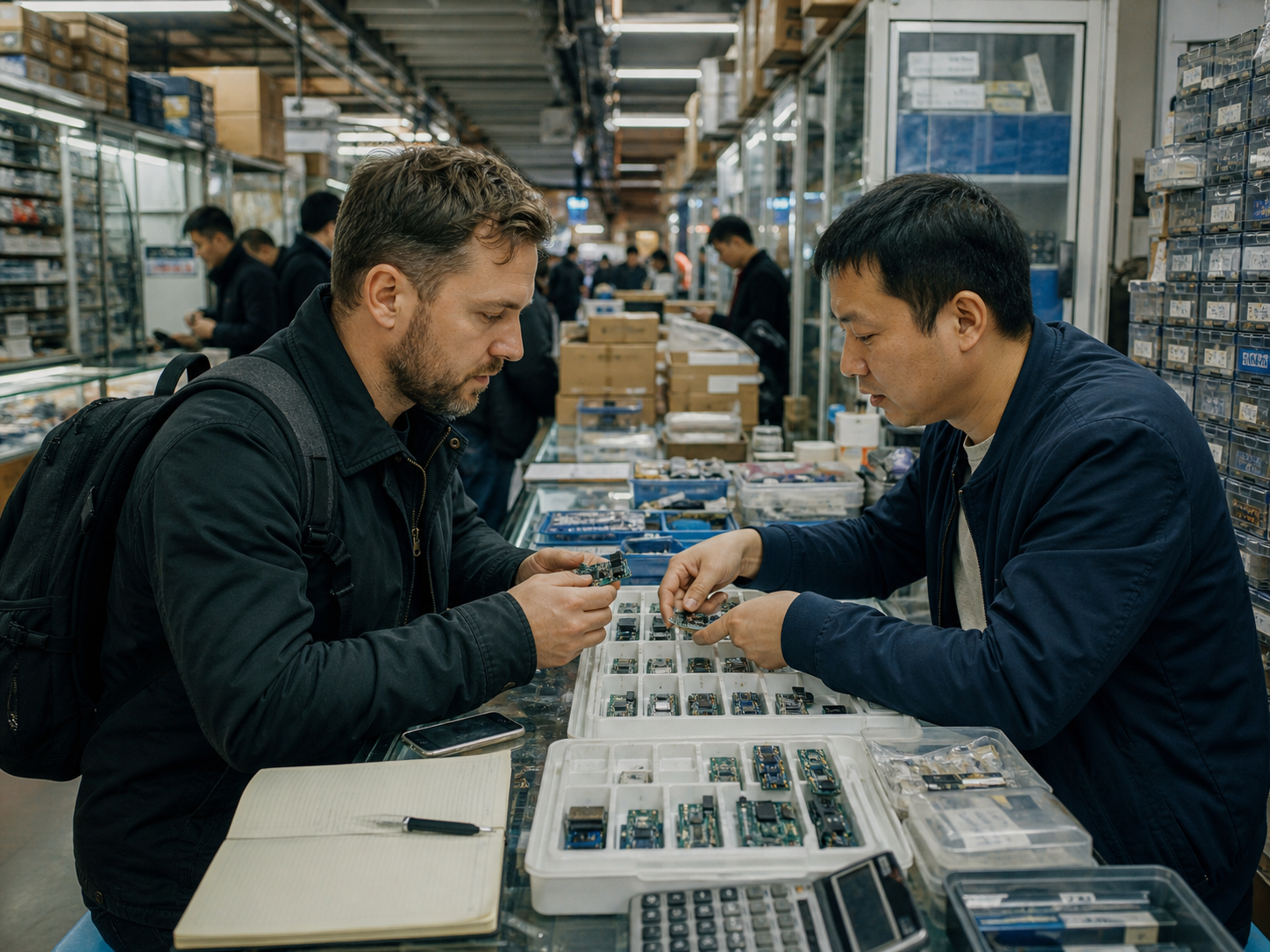
Shenzhen and the wider Pearl River Delta run the highest-density PCB and PCBA ecosystem on the planet. Bao’an and Longgang together host hundreds of fabrication houses, dozens of tier-1 SMT lines, and an unmatched component spot market two metro stops away in Huaqiangbei. The practical effect for a founder: you can go from a clean Gerber file to a populated, functional board in your hand in under a week, and from there into a 5,000-unit production run inside a month. This page covers the categories, MOQs, price bands, specs, process, QC, and the failure modes that quietly eat budgets.
What this covers
This page covers rigid FR4 PCBs (1–16 layers), flexible printed circuits (FPC), rigid-flex hybrids, HDI (high-density interconnect) boards, and metal-core PCBs for thermal applications. It also covers PCBA, surface-mount and through-hole assembly, including paste deposition, reflow, AOI, X-ray, ICT, and functional test. It does not cover semi-flex aluminium for LED strips (a separate sub-category with its own Dongguan cluster) or thick-film ceramic substrates used in RF and power modules.
What Shenzhen and the PRD are uniquely good at
Three things stand out compared to alternatives in Vietnam, Malaysia, or eastern Europe:
- Speed. Sample turnaround on 2L FR4 is 24–72h. No other geography reliably matches that. Most Bao’an houses run two or three shifts and panelise customer designs together to keep machine time saturated.
- Spot-market components. When a chip goes EOL or a passive disappears from Digi-Key for six months, Huaqiangbei has stock. The assembler can walk it back to the line the same afternoon. That is irreplaceable when a design freeze slips into a shortage cycle.
- Process depth. From single-sided FR4 to 12-layer HDI with stacked microvias and via-in-pad, you can stay inside a 30km radius. The same is true for flex and rigid-flex, which most Western prototype houses do not touch.
Sub-categories
| Sub-category | Typical use | Layers / structure | Cluster |
|---|---|---|---|
| 2L FR4 rigid | Sensor breakouts, simple controllers | 2 layers, 1oz Cu | Bao’an quick-turn |
| 4–8L FR4 rigid | Consumer electronics, IoT mains boards | 4–8L, controlled impedance optional | Bao’an, Longgang |
| HDI | Wearables, smartphones, in-ear | 6–12L with microvias and via-in-pad | Longgang specialists |
| Flex (FPC) | Camera modules, hinges, display ribbons | 1–2L polyimide | Longgang |
| Rigid-flex | Foldable devices, dense packaging | Mixed FR4 + polyimide stack | Longgang specialists |
| Metal-core (MCPCB) | LED arrays, motor drivers, power LEDs | Single-layer Cu on aluminium core | Bao’an + Dongguan |
| PCBA (SMT + THT) | Populated boards | Any of the above | Pearl River Delta SMT lines |
MOQs and lead times
| Product | Sample MOQ | Sample LT | Production MOQ | Production LT |
|---|---|---|---|---|
| 2L FR4 | 1–5 boards | 24–72h | 500 | 5–7 days |
| 4–6L FR4 | 2–5 boards | 3–5 days | 500–1,000 | 7–10 days |
| HDI | 5 boards | 7–10 days | 1,000 | 12–18 days |
| Flex / FPC | 5 panels | 5–10 days | 1,000 | 12–18 days |
| Rigid-flex | 5 panels | 10–15 days | 1,000 | 18–25 days |
| MCPCB | 5 boards | 5–7 days | 1,000 | 10–14 days |
| PCBA (≤50 BOM lines) | 5 boards | +5–7 days on PCB | 500 | +5–10 days on PCB |
| PCBA (>100 BOM lines, BGA) | 5 boards | +7–10 days | 500–1,000 | +10–14 days |
Expedite is real and worth budgeting for: most tier-1 Bao’an houses will halve sample turnaround for a 50–100% surcharge.
Price bands
All prices are at the stated MOQ, ex-works Shenzhen, May 2026. USD conversions at ¥7.2.
| Spec | 100 units | 1,000 units | 10,000 units |
|---|---|---|---|
| 2L FR4, 100×100mm, HASL | ¥8–14 (USD 1.10–1.95) | ¥3–6 (USD 0.40–0.85) | ¥1.50–3 (USD 0.20–0.40) |
| 4L FR4, 100×100mm, ENIG | ¥30–55 (USD 4.15–7.65) | ¥12–22 (USD 1.65–3.05) | ¥6–11 (USD 0.85–1.55) |
| 6L FR4, controlled impedance | ¥80–140 (USD 11–19) | ¥28–55 (USD 3.90–7.65) | ¥14–28 (USD 1.95–3.90) |
| 8L HDI, 1+N+1 microvia | ¥220–400 (USD 30–55) | ¥70–140 (USD 9.70–19) | ¥35–75 (USD 4.85–10.40) |
| Single-sided FPC, 50×30mm | ¥18–30 (USD 2.50–4.15) | ¥6–11 (USD 0.85–1.55) | ¥3–6 (USD 0.40–0.85) |
| Rigid-flex 4L | ¥250–450 (USD 35–62) | ¥90–160 (USD 12.50–22) | ¥45–90 (USD 6.25–12.50) |
| PCBA uplift (≤50 BOM, no BGA) | +25–40% | +20–30% | +15–25% |
| PCBA uplift (BGA + RF) | +50–80% | +35–55% | +25–40% |
Component cost is excluded from PCBA uplift, that is purely assembly labour, solder paste, stencil, programming, and test.
Specs to lock down
Before any quote, freeze:
- Layer count and stackup, including dielectric thicknesses and copper weights
- Trace/space minimum and via drill minimum
- Surface finish: HASL, lead-free HASL, ENIG, OSP, immersion silver
- Soldermask colour and silkscreen colour
- Controlled-impedance lines, with target ohms and tolerance
- Panel layout, V-cut vs tab-route, fiducials, tooling holes
- BOM in CSV with MPN, manufacturer, package, polarity notes
- Centroid / pick-and-place file with rotation reference
- Approved distributor list per line item
- IPC class (Class 2 default, Class 3 for medical/automotive)
- AQL targets and which test stages (AOI, X-ray, ICT, FCT) are mandatory
Vague specs are the most expensive mistake in PCBA. Assemblers will substitute components silently if the BOM says “10µF cap” with no MPN.
Process
- Quote against Gerbers, drill file, stackup, BOM, and centroid.
- DFM review from the fab and DFA review from the assembler, expect 5–20 minor flags on a first design.
- Sample build: bare PCB first, then PCBA when boards pass electrical test.
- First-article inspection: 3–5 boards fully tested against your spec, with photos, X-ray of BGA/QFN, and ICT/FCT logs.
- Engineering sign-off, then production release.
- Production build in batches, with AOI + X-ray inline and FCT on a sampling plan or 100% as specified.
- Pack, label, and ship, usually FOB Shenzhen or Hong Kong air.
QC specifics
- AOI on every board after reflow, before any further handling.
- X-ray on all BGA, QFN, LGA, and any package with hidden joints; demand void-area reports under 25% per joint.
- ICT (in-circuit test) catches wrong-value passives and reversed polarised parts; cost-effective above ~1,000 units when the bed-of-nails fixture amortises.
- Flying probe is the alternative for low/mid volume, slower per board but no fixture cost.
- FCT (functional test) exercises the board as a product: power it up, run firmware, verify I/O. Always insist on FCT; AOI alone misses cold joints that pass visual.
- For high-reliability boards, demand cross-section micro-section reports on first article, they show via plating thickness, layer registration, and copper adhesion.
What goes wrong
- Refurbished or remarked ICs. Mitigation: name the distributor in the BOM, demand date-code photos, X-ray BGAs, compare die markings against the datasheet.
- Solder paste mismatch on fine-pitch parts. Mitigation: insist the assembler shares stencil thickness and aperture reduction percentages; review against IPC-7525.
- Controlled impedance off-target. Mitigation: require coupon measurements with a TDR on every panel; tolerance ±10% is the standard.
- Silent BOM substitution. Mitigation: lock approved manufacturer list per line; any substitution requires written approval and a new first article.
- Moisture-sensitive devices baked badly. Mitigation: confirm MSD handling per JEDEC J-STD-033; demand humidity-indicator card photos on dry packs.
- Panelisation breaks delicate boards. Mitigation: review V-cut depth and tab-route mouse-bite count on the panel drawing; reject anything that flexes mounted components during depanel.
- No traceability when a field failure shows up. Mitigation: require date-code labels per panel and lot-level component traceability in the assembler’s MES.
Certifications
For end-product certification, your PCB choices matter:
- UL 94 V-0 flame rating on the laminate, standard on FR4 from any tier-1 house, but ask for the cert sheet.
- RoHS and REACH declarations on laminate, soldermask, and solder paste.
- IPC-A-600 for bare board acceptance, IPC-A-610 for assembly acceptance, Class 2 is consumer default, Class 3 is medical/aerospace.
- IPC-6012 for rigid board qualification, IPC-6013 for flex.
- For end-product CE / FCC / UKCA / KC / PSE, the PCB itself is not certified, the assembled product is. But layout decisions (return paths, decoupling, EMI shielding) drive whether you pass first-pass EMC.
Trade shows
- HKTDC Electronics Fair (Hong Kong, April and October), tier-1 fabs and assemblers, plus components.
- Canton Fair (Guangzhou, April and October), broad-stroke; Phase 1 covers electronics. Less specialised but useful for breadth.
- ELEXCON (Shenzhen, late summer), domestic-focused, deep on components and design tools.
- productronica China (Shanghai, March, biennial), process and equipment side; useful if you are evaluating where your supplier sits on the technology curve.
When to use us
If you are sourcing PCBs or PCBA from outside China for the first time, the failure modes above are the ones that quietly drain runway. The sourcing desk handles supplier shortlisting, BOM scrubbing, sample procurement, and first-article review remotely. The hardware founder tour is the in-person version, we walk you through tier-1 Bao’an fabs and Pearl River Delta SMT lines, sit with you in DFM reviews, and translate the parts of the conversation that decide unit cost.
Last reviewed: 23 May 2026.
Frequently asked questions
What's the practical difference between PCB-only and PCBA?
PCB is the bare fibreglass board with traces and pads, no parts. PCBA is the populated assembly, with components soldered down. PCB-only makes sense when you're hand-assembling in-house, doing low-volume R&D, or shipping bare boards to a separate contract manufacturer. For anything above ~100 units you almost always want PCBA from the same Shenzhen house: it removes a logistics hop, lets the assembler match solder paste and reflow profile to their own boards, and gives you one supplier to blame when something fails.
How fast can I get a 2-layer FR4 prototype?
A tier-1 Bao'an quick-turn house can panelise, expose, etch, drill, mask, silk, and HASL or ENIG a 2-layer FR4 sample in 24 hours if the Gerbers are clean and you pay the expedite fee (typically 1.5–2× standard). 48–72h is the comfortable number for standard turnaround. 4L is 3–5 days, 6L is 5–7 days, HDI with blind/buried vias is 7–10 days minimum.
When does HDI pay off?
HDI (microvias, blind/buried, ≥0.2/0.2mm trace/space) is worth the 3–5× cost premium when (1) your BGA pitch is ≤0.5mm and you cannot fan out with through-holes, (2) you need to halve board area for a wearable or in-ear device, or (3) signal integrity at >1Gbps requires shorter return paths. Below those thresholds, a 6L or 8L FR4 stackup is almost always cheaper and faster.
How do I avoid getting refurbished ICs in my PCBA?
Specify the authorised distributor by name (LCSC, Digi-Key, Mouser, Arrow) in your BOM, demand date-code photos before placement, and pay the 5–10% premium for the assembler to source through them rather than the Huaqiangbei spot market. For high-value chips, request X-ray of the BGA balls on first-article boards and compare die markings against the manufacturer datasheet under a 10× loupe. Refurbished ICs typically show inconsistent ball geometry and faded laser marks.
What's a realistic AQL for PCBA out of Shenzhen?
AQL 1.5 for major defects (shorts, opens, missing components, wrong polarity) and AQL 2.5 for minor cosmetics is the standard contract. Tier-1 Pearl River Delta SMT lines hit those numbers consistently with AOI + ICT + flying probe in line. If your end product is medical or automotive, demand AQL 0.65 plus 100% functional test, and expect to pay 8–15% more per board.
Can I split PCB and assembly between two suppliers to save money?
You can, and a lot of teams do it for early prototypes, bare boards from one quick-turn house, hand assembly in-house. For production it almost never saves real money. You pay double freight, lose the assembler's ability to tweak paste deposit for their reflow oven, and introduce a finger-pointing gap when joints fail. Keep PCB and PCBA together once you cross ~500 units, and you'll spend the saved coordination time on actual product work.