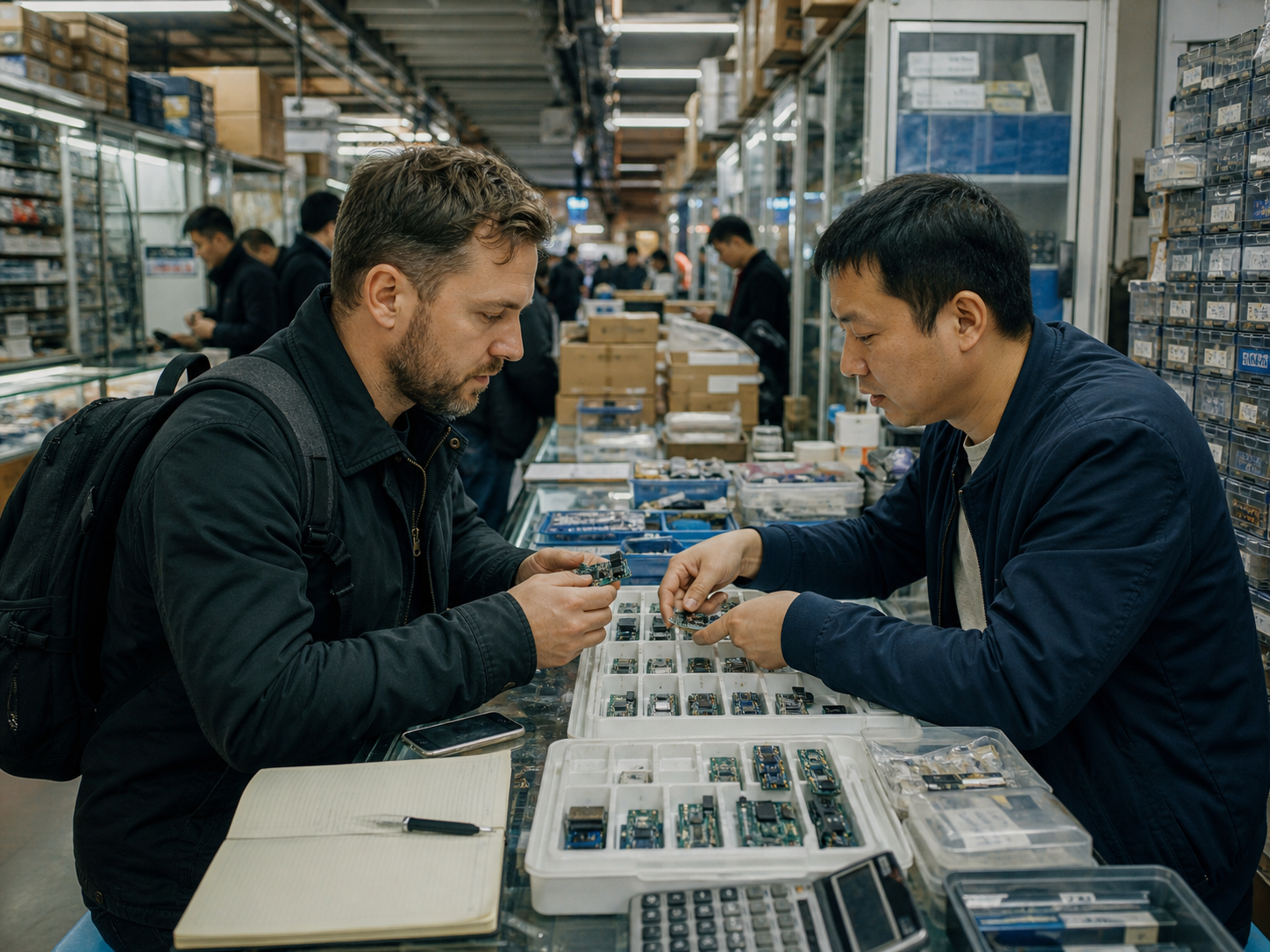
Prototyping is where hardware projects live or die, fast iteration with realistic materials lets you find problems while they’re cheap to fix, slow iteration with the wrong materials means you discover problems after tooling is cut. Bao’an’s prototyping ecosystem is purpose-built for this loop: every major prototyping process sits within a 15km radius, samples ship overnight to Hong Kong, and the same shops that build your prototypes often run pilot and production volumes. For a hardware founder, that means you can move from sketch to functional prototype to user-test batch to pilot production without changing geography.
What this covers
This page covers physical prototyping services available in Shenzhen: 3D printing (SLA, MJF, FDM, SLS, DLP), CNC machining quick-turn (3–7 days for aluminium and engineering plastics), urethane casting from silicone moulds, vacuum casting, PCB quick-turn fabrication, PCBA prototype assembly, 3D-printed jigs and fixtures, and prototype paint, plating, and finish services. It does not cover full pilot production runs (covered under the specific process pages, injection moulding, CNC machining, PCBs) or custom electronics design services.
What Shenzhen and the PRD are uniquely good at
- Co-located processes. SLA, MJF, CNC, PCB fab, PCBA, and finish services all sit within a 20km radius. A multi-process prototype (CNC enclosure + SLA front face + custom PCBA inside + spray paint) lands in your hand in 5–7 days.
- Production-supplier prototyping. Many Bao’an CNC and injection-mould suppliers will run prototypes themselves, surfacing DFM issues during prototyping instead of discovering them after tooling.
- Cost. Prototype pricing is 40–60% lower than US/EU equivalents at similar quality.
- Overnight finishing. Spray-paint, silk-screen, laser-etch, and pad-print can be added to most prototypes with same-day or next-day turnaround.
- PCB quick-turn. 24-hour 2-layer FR4 is a real service from multiple tier-1 Bao’an houses; 48–72h PCBA is realistic for moderate-complexity boards.
Sub-categories
| Sub-category | Process | Use case | Cluster |
|---|---|---|---|
| SLA / DLP | UV-cured resin | Visual / cosmetic models, master patterns | Bao’an |
| MJF | HP Multi-Jet Fusion nylon | Functional plastic prototypes | Bao’an specialists |
| SLS | Selective laser sintering nylon | Functional plastic, slightly rougher than MJF | Bao’an |
| FDM | Extruded filament | Fast cheap iterations, fixtures, throwaway | Across PRD |
| Metal 3D printing (DMLS / SLM) | Laser-sintered metal powder | Complex metal geometries, very low volume | Specialist Bao’an shops |
| CNC quick-turn | 3-axis / 5-axis CNC | Production-grade functional parts | Bao’an |
| Urethane casting | Silicone moulds, PU resin | 10–100 production-like parts | Bao’an |
| Vacuum casting | Variant of urethane casting under vacuum | Higher-quality parts, fewer voids | Bao’an |
| Silicone moulding | RTV silicone for soft parts | Gaskets, soft grips, demo parts | Bao’an |
| PCB quick-turn | FR4, flex, MCPCB | Electronics prototypes | Bao’an + Longgang |
| PCBA prototype | SMT line in prototype mode | Populated boards | Bao’an PCBA lines |
| Prototype paint / finish | Spray, anodise, silk-screen, pad print | Production-look samples | Bao’an + Dongguan |
| 3D-printed jigs / fixtures | FDM or SLA | Assembly aids, test fixtures | Bao’an + Dongguan |
MOQs and lead times
| Process | MOQ | Lead time |
|---|---|---|
| SLA / DLP | 1 part | 24–48h |
| MJF | 1 part | 48–72h |
| SLS | 1 part | 48–72h |
| FDM | 1 part | 24h (often same day) |
| Metal 3D print (DMLS) | 1 part | 5–10 days |
| CNC quick-turn aluminium | 1 part | 3–7 days |
| CNC quick-turn stainless | 1 part | 5–10 days |
| Urethane cast (after master + mould) | 10–100 parts per mould | Mould 3–5 days, cast 7–10 days |
| Silicone moulding (soft parts) | 10–50 per mould | 5–10 days |
| PCB quick-turn (2L FR4) | 1 board | 24h |
| PCB quick-turn (4L FR4) | 1 board | 48–72h |
| PCBA prototype | 5 boards | +3–5 days on PCB |
| Spray paint / finish | 1 part | +1–3 days |
| Anodise (Type II any colour) | 1 part | +2–4 days |
| Silk-screen / pad print | 1 part | +1–2 days |
| 3D-printed jig / fixture | 1 unit | 24–48h |
Price bands
All prices at the stated quantity, ex-works Shenzhen, May 2026. USD conversions at ¥7.2. Reference part: roughly 80×60×30mm with moderate complexity.
| Process | Single part | 10 parts | 50 parts |
|---|---|---|---|
| SLA (standard resin) | ¥120–280 (USD 16.70–38.90) | ¥80–200 (USD 11.10–27.80) | n/a (move to urethane cast) |
| SLA (tough / engineering resin) | ¥250–500 (USD 34.70–69.40) | ¥180–380 (USD 25–52.80) | n/a |
| MJF (nylon PA12) | ¥250–500 (USD 34.70–69.40) | ¥180–400 (USD 25–55.60) | ¥120–280 (USD 16.70–38.90) |
| SLS (nylon PA12) | ¥280–550 (USD 38.90–76.40) | ¥200–420 (USD 27.80–58.30) | ¥140–300 (USD 19.45–41.70) |
| FDM (PLA / ABS) | ¥40–150 (USD 5.55–20.80) | ¥30–110 (USD 4.17–15.30) | n/a |
| Metal 3D print (stainless 316L) | ¥1,800–4,500 (USD 250–625) | ¥1,400–3,500 (USD 195–486) | quote |
| CNC aluminium 6061-T6 (quick-turn) | ¥350–700 (USD 48.60–97.20) | ¥220–500 (USD 30.60–69.40) | ¥120–280 (USD 16.70–38.90) |
| CNC stainless 304 (quick-turn) | ¥550–1,100 (USD 76.40–152.80) | ¥380–800 (USD 52.80–111.10) | ¥220–500 (USD 30.60–69.40) |
| CNC POM / PEEK (quick-turn) | ¥200–800 (USD 27.80–111.10) | ¥150–600 (USD 20.80–83.30) | ¥85–400 (USD 11.80–55.60) |
| Urethane cast batch (50 parts) | n/a | n/a | ¥4,000–12,000 total (USD 555–1,670) |
| Silicone mould setup (for urethane casting) | ¥1,500–4,000 one-time | amortised | amortised |
| Vacuum cast batch (better quality) | n/a | n/a | ¥6,000–18,000 total (USD 830–2,500) |
| PCB quick-turn 2L (5 boards, palm size) | n/a | ¥150–400 total | ¥250–700 total |
| PCB quick-turn 4L (5 boards) | n/a | ¥350–900 total | ¥550–1,500 total |
| PCBA prototype (5 boards, 30-component BOM) | n/a | ¥1,500–4,500 total | ¥2,500–8,000 total |
| Spray paint + clearcoat (per part) | ¥30–120 (USD 4.17–16.70) | ¥25–90 (USD 3.47–12.50) | ¥18–65 (USD 2.50–9.03) |
| Pad print (1 colour, per part) | ¥15–40 (USD 2.08–5.55) | ¥10–28 (USD 1.39–3.89) | ¥6–18 (USD 0.83–2.50) |
Specs to lock down
- For 3D printing: STL or STEP file, material grade, layer height (50–100 µm typical for visual, 100–200 µm for functional), post-processing (sanded, painted, dyed), tolerance expectation (±0.2mm typical for SLA, ±0.3mm for MJF, ±0.5mm for FDM)
- For CNC: STEP + drawing, material grade and temper, critical tolerances, surface finish (Ra)
- For urethane casting: master quality requirement (typically SLA-printed), material spec (Shore hardness for elastomers, equivalent properties for rigid PU like “PC-like” or “ABS-like”), colour, batch size
- For PCB quick-turn: Gerbers, drill file, stackup, surface finish, soldermask colour
- For PCBA prototype: BOM with MPN, centroid file, consignment vs supplier-sourced parts
- For finishing: paint colour with Pantone reference, finish (matt / satin / gloss), masking spec, print artwork file with placement
Process
- Define the question the prototype needs to answer (looks, fit, function, user testing, regulatory submission).
- Select prototyping process matched to the question.
- CAD prep: tessellation tolerance for STL (typically 0.05mm chord height), wall thickness check, draft angle review if pre-mould prototype.
- Quote with file submission; quotes typically returned within 4–24 hours.
- Approve quote, place order, ship file to production.
- Production: 24h to 7 days depending on process.
- QC at the prototyping shop: visual, dimensional check on critical features.
- Ship via overnight courier to Hong Kong, then international air.
- Hands-on evaluation against the prototyping question, decide next iteration.
QC specifics
- 3D-printed parts: dimensional check on 3–5 critical features, surface finish visual, defect inspection (layer lines, voids, support marks).
- CNC parts: hand-caliper check on critical dimensions, surface finish visual, no sharp burrs.
- Urethane-cast parts: visual for bubbles and short shots, dimensional verification of first part out of mould, batch consistency check.
- PCB quick-turn: visual for trace defects, continuity test on critical nets.
- PCBA prototype: visual for solder quality, basic power-on and smoke test, functional verification if test fixture available.
- Painted / finished parts: colour match check, finish uniformity, no overspray on masked areas.
What goes wrong
- 3D-printed part doesn’t match CAD dimensions. Mitigation: tessellation tolerance set correctly, design with shrinkage allowance, verify dimensions on receipt before approving next iteration.
- SLA resin part brittle or yellowed. Mitigation: spec the right resin grade for the application (tough resin for snap-fits, clear engineering resin for cosmetic), UV-stabilise if outdoor use.
- CNC quick-turn part loses tight tolerance to save time. Mitigation: call out tight tolerances explicitly; accept that quick-turn typically defaults to ±0.1mm and demand CMM if tighter.
- Urethane-cast batch has cosmetic voids. Mitigation: vacuum-cast vs standard urethane cast; first-part inspection before completing the batch.
- PCB quick-turn arrives with soldermask issues. Mitigation: review approval is brief; spec colour and minimum thickness; visually compare to your standard before assembly.
- PCBA prototype non-functional due to incorrect part substitution. Mitigation: explicit “no substitutions” on prototype BOM; LCSC-sourced parts with documented MPN.
- Paint colour doesn’t match Pantone or reference. Mitigation: physical reference panel sent to shop; colour-match approval before painting the full batch.
Certifications
Prototyping is generally pre-certification, so formal cert documentation rarely applies at this stage. Useful to specify:
- Material safety / restricted substances if prototypes will be used by humans (urethane resin properties for skin contact, paint formulation for child-accessible parts).
- Process compliance for medical or regulatory submissions, some labs require prototype materials to match the production-intent material spec for pre-clinical or pre-submission studies.
- RoHS-compliant materials when prototypes need to validate end-product compliance.
Trade shows
- TCT Asia (Shanghai) (March), additive manufacturing and prototyping technology; useful for evaluating equipment suppliers and emerging materials.
- Formnext (Frankfurt) (November), international additive manufacturing; not in China but PRD prototyping suppliers often exhibit.
- HKTDC Electronics Fair (April, October), PCB and PCBA prototype suppliers exhibit.
- Productronica China (Shanghai, March, biennial), equipment side, useful to gauge what processes your suppliers run.
- CCMT / CIMT (Shanghai or Beijing), machine tools side, including CNC prototyping equipment.
When to use us
Prototyping is where time is most valuable, every wasted iteration cycle is a week off the launch. The sourcing desk handles process selection, supplier shortlisting, quote review, and prototype shipment coordination, most useful when your team is iterating remotely and needs a Shenzhen-based hand to keep prototypes moving. The hardware founder tour is the in-person version, sitting in CNC shops while your part is cut, walking PCB quick-turn lines, and watching urethane casting from master through batch in real time.
Last reviewed: 23 May 2026.
Frequently asked questions
SLA, MJF, or FDM, which 3D-printing process for my prototype?
SLA (resin) for visual prototypes, high detail, smooth surfaces, best for cosmetic appearance models, master patterns for casting. MJF (HP multi-jet fusion, nylon) for functional plastic parts, strong, isotropic, near-production properties, good for snap-fits and mechanisms. FDM (extruded filament) for fast cheap prototypes where finish doesn't matter, fixtures, jigs, rough form studies. Default to SLA for looks, MJF for function, FDM for throwaway iterations. SLS (selective laser sintering) sits between MJF and SLA but is less common in PRD prototyping shops now that MJF has taken over the nylon market.
When should I use CNC quick-turn instead of 3D printing?
CNC when you need real engineering materials (6061-T6 aluminium, brass, stainless, POM, PEEK) and real production-grade mechanical properties. 3D printed plastics, even MJF nylon, behave differently from injection-moulded ABS or PC, UV resistance, thermal stability, dimensional accuracy under load. If your prototype needs to survive functional testing under real conditions, CNC it. The cost is higher (¥350–700 per palm-sized aluminium part vs ¥150–250 for SLA) and the lead time is longer (3–7 days vs 24–48h), but the answer you get is the real answer.
What is urethane casting and when does it pay off?
Urethane casting (also called silicone moulding or RTV casting) uses a silicone rubber mould made from a master pattern (often SLA-printed) to cast 10–100 polyurethane copies. Cost per part is ¥80–250 depending on size and material; mould setup is ¥1,500–4,000. Pays off when you need 10–100 parts that look and feel close to production plastic, user testing, beta units, marketing samples, regulatory submission, but injection moulding tooling (¥30,000–100,000) is overkill for the quantity. Lead time is 10–14 days for a typical batch.
How do I get a PCB prototype in 24 hours?
Tier-1 Bao'an quick-turn PCB houses offer 24-hour service on 2-layer FR4 boards with standard specs (1oz copper, HASL finish, no impedance control, no special soldermask colour). Submit clean Gerbers before noon, expect boards by end of the next business day. Premium is typically 1.5–2× standard pricing, a ¥3 board becomes ¥5–6. 4-layer 24h is possible at a smaller subset of shops at 2–3× premium. PCBA in 48–72h is realistic for boards under 50 components, assuming all parts are stocked locally (LCSC or Huaqiangbei).
Should I prototype in Shenzhen or at home and ship to production?
Prototype where iteration speed is highest. For most hardware founders that means a mix: 3D-print and CNC at home for daily iteration during early design, then prototype in Shenzhen once you're within 1–2 months of pilot production. Shenzhen prototyping pays off when (a) lead time matters more than overnight Hong Kong shipping (rare), (b) you want the production supplier to also build the prototype to surface DFM issues early, or (c) you're already in Shenzhen for other reasons. Don't add international shipping legs to a daily iteration loop, that destroys speed.
What's the realistic prototyping budget for a hardware product before tooling?
For a moderately complex consumer hardware product (mechanical assembly + PCBA + soft goods or packaging) before injection-mould tooling: ¥40,000–150,000 (USD 5,500–20,800) across 3–6 design iterations spanning 3–6 months. Breakdown: 3D-printed appearance models ¥3,000–8,000 per iteration, CNC functional parts ¥5,000–15,000 per iteration, PCB+PCBA prototypes ¥4,000–12,000 per iteration, urethane-cast user-test batches ¥8,000–25,000 each. Going lighter than ¥40,000 means rushing into tooling under-tested; going heavier than ¥150,000 usually means you're prototyping past the point of diminishing returns and should freeze and commit to tooling.