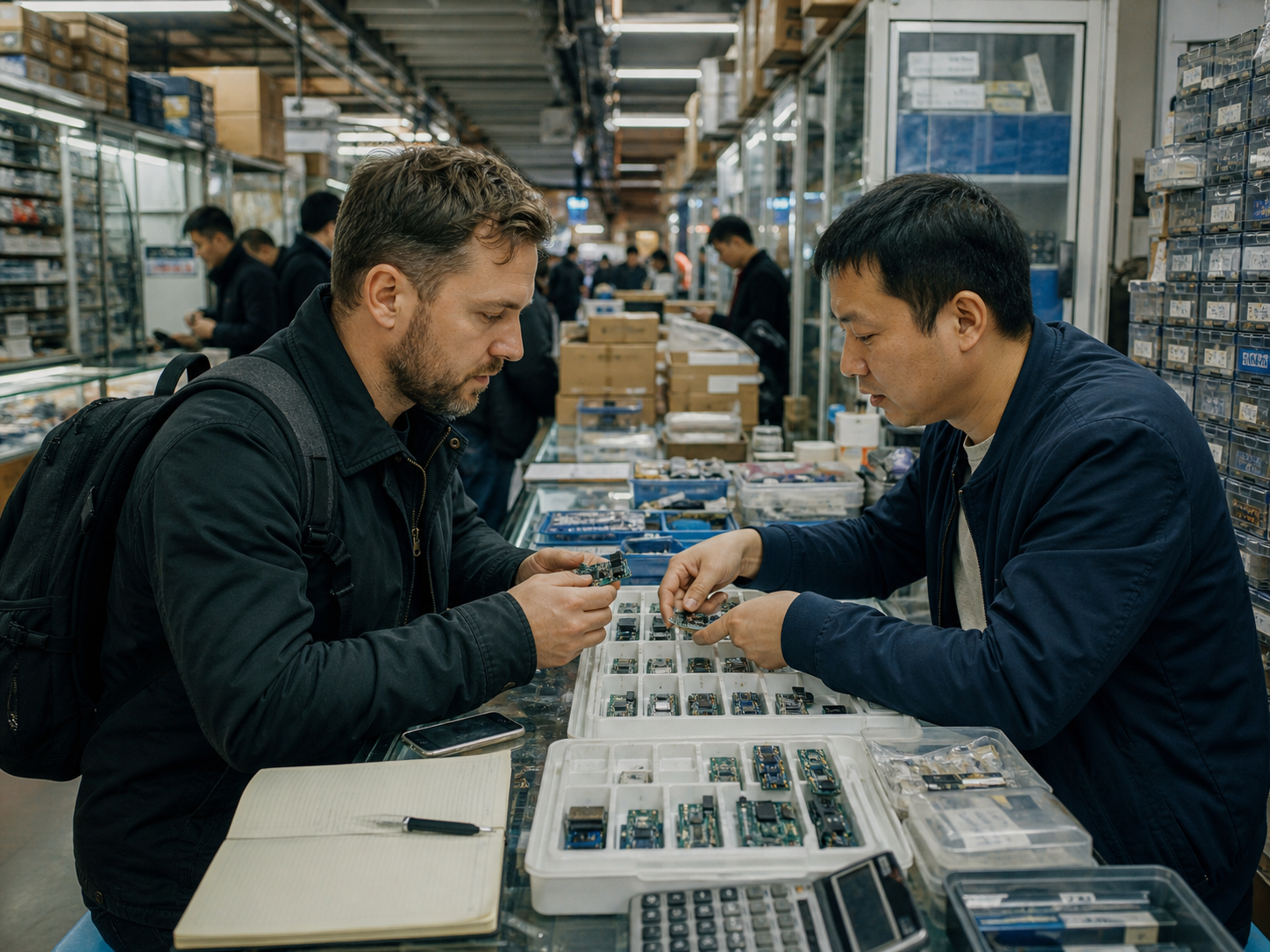
Robotics has become one of the deepest hardware sub-categories in the Pearl River Delta. Five years ago the ecosystem was thin and Chinese-only, today, Bao’an and Dongguan cover the full robotics stack from BLDC motors and harmonic drives to LiDAR sensors and end-effectors, with quality and pricing that compete globally on most categories. For hardware founders building robots, whether industrial, service, mobile, or consumer, the practical effect is that you can prototype with off-the-shelf modules in weeks and produce in low-thousands quantities at competitive unit cost.
What this covers
This page covers robotics components and sub-assemblies sourced in Shenzhen and the surrounding Pearl River Delta: BLDC motors, servos, steppers, motor drivers and ESCs, planetary and harmonic gearheads, encoders (incremental and absolute), AGV / AMR base platforms, robotic manipulators, end-effectors (grippers, vacuum, magnetic), LiDAR sensors, depth cameras, structural extrusions and linear motion. It does not cover full robot system integration (a separate engineering service) or industrial safety controllers (specialised suppliers, often imported).
What Shenzhen and the PRD are uniquely good at
- Motor and drive integration. The Bao’an cluster covers BLDC, servo, stepper, and motor drivers under one roof; matching driver to motor and tuning FOC is a same-day conversation.
- Cost competitive on commodity robotics parts. Planetary gearheads, encoders, stepper motors, basic LiDAR, all priced 30–50% below comparable Western alternatives.
- Custom mechanical at speed. Pair Bao’an CNC and the local extrusion suppliers, and you can iterate a structural design in 1–2 week cycles.
- AGV and AMR platforms. Dongguan and Bao’an dominate the global AGV base platform market, both off-the-shelf and customised chassis are available with short lead times.
- Sensor module ecosystem. Depth cameras, ToF sensors, IMUs, and LiDAR modules are all available from local suppliers, often with reference firmware and SDKs.
Sub-categories
| Sub-category | Sub-items | Cluster |
|---|---|---|
| Motors | BLDC, servo (BLDC + controller), stepper, hobby servo, vibration motors | Bao’an + Dongguan |
| Motor drivers & ESCs | FOC drivers, stepper drivers, ESC for drone/RC | Bao’an |
| Gearheads | Planetary, harmonic, cycloidal, worm | Bao’an + Dongguan |
| Encoders | Incremental, absolute (single-turn, multi-turn), optical, magnetic | Bao’an |
| AGV / AMR platforms | Differential, omni-directional, tracked | Dongguan + Bao’an |
| Manipulators | 4-axis SCARA, 6-axis arms, cobots | Dongguan specialists |
| End-effectors | Parallel grippers, vacuum, magnetic, soft pneumatic | Bao’an specialists |
| LiDAR | 2D rotating, 3D rotating, solid-state, MEMS-based | Bao’an + Dongguan |
| Depth cameras | ToF, structured light, stereo | Bao’an |
| Structural | Aluminium extrusion (T-slot), linear rails, ball screws, shafts | Foshan + Dongguan |
MOQs and lead times
| Item | MOQ | Lead time |
|---|---|---|
| Off-the-shelf BLDC / servo / stepper motor | 1 (sample), 50 (production) | 1–4 weeks |
| Custom-wound motor | 500–2,000 | 6–10 weeks |
| Motor driver / ESC | 1 (sample), 100 (production) | 1–4 weeks |
| Planetary gearhead, stock | 1 (sample), 50 (production) | 2–4 weeks |
| Harmonic gearhead, stock | 1 (sample), 50 (production) | 4–8 weeks |
| Custom gearhead | 200+ | 10–14 weeks |
| Encoder (off-the-shelf) | 1 (sample), 100 (production) | 2–4 weeks |
| AGV / AMR base platform (off-the-shelf) | 1 (sample), 10 (production) | 4–8 weeks |
| AGV / AMR custom platform | 20–50 | 10–14 weeks |
| 6-axis manipulator (off-the-shelf) | 1 (sample), 5 (production) | 4–8 weeks |
| End-effector (off-the-shelf) | 1 (sample), 50 (production) | 2–6 weeks |
| End-effector (custom) | 100–500 | 8–14 weeks |
| LiDAR module (off-the-shelf) | 1 (sample), 100 (production) | 2–4 weeks |
| Depth camera module (off-the-shelf) | 1 (sample), 100 (production) | 2–4 weeks |
| Aluminium extrusion (standard profile) | 100m | 1–2 weeks |
| Linear rail / ball screw set | 1 (sample), 50 (production) | 1–3 weeks |
Price bands
All prices at the stated quantity, ex-works Pearl River Delta, May 2026. USD conversions at ¥7.2.
| Item | 1 unit | 100 units | 1,000 units |
|---|---|---|---|
| BLDC motor, 100W class | ¥180–400 (USD 25–55) | ¥120–280 (USD 16.70–38.90) | ¥85–200 (USD 11.80–27.80) |
| BLDC servo, 200W class with controller | ¥600–1,400 (USD 83–195) | ¥450–950 (USD 62–132) | ¥320–700 (USD 44–97) |
| Stepper NEMA 17 | ¥55–120 (USD 7.65–16.70) | ¥45–95 (USD 6.25–13.20) | ¥35–75 (USD 4.85–10.40) |
| FOC motor driver, 30A | ¥180–450 (USD 25–62) | ¥130–320 (USD 18–44) | ¥90–230 (USD 12.50–32) |
| Planetary gearhead, 20:1, mid grade | ¥250–600 (USD 35–83) | ¥180–420 (USD 25–58) | ¥130–300 (USD 18–42) |
| Harmonic gearhead, 100:1, mid grade | ¥2,500–6,000 (USD 350–830) | ¥1,800–4,500 (USD 250–625) | ¥1,300–3,200 (USD 180–445) |
| Encoder, 13-bit absolute | ¥220–550 (USD 30–76) | ¥170–420 (USD 24–58) | ¥120–300 (USD 17–42) |
| 2D rotating LiDAR (10m range) | ¥800–2,000 (USD 110–280) | ¥550–1,400 (USD 76–195) | ¥400–1,000 (USD 55–140) |
| Solid-state LiDAR (40m range) | ¥1,800–5,000 (USD 250–695) | ¥1,200–3,500 (USD 167–485) | ¥800–2,500 (USD 110–350) |
| Depth camera (ToF, 5m range) | ¥600–1,800 (USD 83–250) | ¥420–1,200 (USD 58–167) | ¥300–850 (USD 42–118) |
| AGV base platform (50kg, differential) | ¥10,000–18,000 (USD 1,390–2,500) | ¥7,500–14,000 (USD 1,040–1,940) | quote |
| 6-axis robot arm (5kg payload) | ¥18,000–50,000 (USD 2,500–6,950) | ¥14,000–38,000 (USD 1,940–5,280) | quote |
| Parallel electric gripper (1kg) | ¥600–1,500 (USD 83–210) | ¥420–1,100 (USD 58–153) | ¥300–800 (USD 42–110) |
| Aluminium extrusion 30×30 T-slot | ¥22–40 per metre (USD 3.05–5.55) | ¥18–32 per metre | ¥14–28 per metre |
| Linear rail set (15mm, 500mm length) | ¥250–550 (USD 35–76) | ¥180–420 (USD 25–58) | ¥130–320 (USD 18–44) |
Specs to lock down
- Motor: continuous torque, peak torque, rated speed, rated voltage, rated current, mechanical interface (shaft diameter, mounting flange), encoder type and resolution
- Gearhead: ratio, backlash spec (arcmin or arcsec), rated input torque, output torque, mechanical interface compatibility with motor
- Driver / ESC: input voltage, peak current, continuous current, communication protocol (CAN, RS485, EtherCAT, PWM, UART), cooling
- LiDAR: range, range under named reflectivity, point rate, scan rate, field of view, interface
- Camera: resolution, frame rate, depth range, depth accuracy, field of view, interface (USB, MIPI, GigE)
- Mechanical: payload, reach, repeatability, environmental (IP rating, operating temp)
- Communication and software: API, SDK availability, ROS support, programming examples
- Certification: CE, FCC, KC for electronic modules; ISO 10218 / 13849 for collaborative robots if applicable
Process
- System architecture: define joint count, payload, reach, speed, accuracy, environment.
- Component selection per joint or sub-system with second-source identified.
- Sample procurement: 1–3 of each major component for mechanical and software validation.
- Bench prototype: assemble, characterise (torque, speed, accuracy under load).
- Software / firmware integration with selected drivers and communication stack.
- Custom mechanical design (CNC brackets, extrusion frame), pair with the Bao’an CNC shop.
- Pilot build: 5–10 units to validate assembly process and identify integration issues.
- Production: scale via existing supplier relationships, with incoming inspection and burn-in testing.
- Field validation and rework based on initial deployments.
QC specifics
- Motor incoming: no-load current draw, locked-rotor current, torque at rated speed (sample basis).
- Gearhead incoming: backlash measurement under reference torque, no-load drag, sample tear-down on first batch.
- Encoder incoming: counts-per-revolution verification, index pulse alignment, output signal integrity.
- Driver/ESC incoming: bench test at rated current with rated motor, thermal soak test (60 minutes at rated load).
- LiDAR incoming: range under named targets (white, grey, black at 1m and rated range), point density verification, angular accuracy with a known fixture.
- Assembly: torque-spec all mechanical joints, verify cable routing for cycle life, run-in test for 30–120 minutes before final QC.
What goes wrong
- Gearhead backlash under-spec. Mitigation: bench-measure backlash on incoming samples; lock supplier on a measurement protocol; reject batches exceeding spec.
- LiDAR range claims optimistic. Mitigation: bench-test under your actual target reflectivity (not lab whites); accept slip of 20% from spec under field conditions.
- Motor thermal failure under sustained load. Mitigation: thermal soak test at rated load for 60+ minutes; spec continuous torque conservatively (50–70% of catalogue peak).
- Encoder drift over temperature. Mitigation: thermal cycle test (-10°C to +60°C); prefer magnetic absolute over optical incremental for harsh environments.
- Driver firmware version mismatch. Mitigation: lock firmware version per batch; verify on incoming; lot-level traceability.
- AGV navigation drift over time. Mitigation: SLAM calibration protocol per platform; encoder-wheel calibration after assembly; periodic recalibration in field.
- End-effector cycle life shorter than rated. Mitigation: insist on documented cycle-life test data; run accelerated life test (1M cycles in 2 weeks) on pilot units; budget for replacement schedule rather than expecting infinite life.
Certifications
- CE / FCC / KC for electronic modules (drivers, LiDAR, cameras).
- ISO 10218 for industrial robots, ISO 15066 for collaborative robots, required for sale into industrial settings.
- ISO 13849 for safety control systems in robotics, required for any safety-critical motion.
- ISO 3691-4 for AGV/AMR safety in industrial settings.
- EMC testing (EN 61000) for electronic robotic systems.
- IP rating (IP54, IP65, IP67) for motors, drivers, and enclosures in non-clean environments.
- MEMS LiDAR functional safety (ISO 26262) for automotive use, narrows supplier list sharply.
Trade shows
- CIROS / China International Robot Show (Shanghai, summer), the largest dedicated robotics show in China.
- HKTDC Electronics Fair (April, October), robotics components and sub-assemblies exhibit alongside electronics.
- Industrial Automation Show (IAS) (Shanghai, November), robotics, motion control, and industrial automation.
- Canton Fair Phase 1 (April, October), machinery section includes many robotics suppliers.
- ELEXCON (Shenzhen, late summer), embedded electronics for robotics.
- High-Tech Fair (CHTF) (Shenzhen, November), emerging robotics and AI hardware.
When to use us
Robotics sourcing rewards engineering depth, picking the wrong motor / gearhead / encoder combination can quietly compound into a robot that doesn’t meet spec months into development. The sourcing desk handles supplier shortlisting, spec review, sample procurement, and incoming-test protocol design remotely. The hardware founder tour is the in-person version, walking Bao’an motor lines, Dongguan AGV factories, and end-effector specialists so you understand what’s being built.
Last reviewed: 23 May 2026.
Frequently asked questions
BLDC, servo, or stepper, how do I choose for my robot joint?
Stepper for low-cost positioning where speed and torque needs are modest (small AGVs, basic positioners), open-loop, simple driver, cheap. BLDC with encoder for high-speed continuous applications (drones, mobile platforms, fans, pumps), efficient, high power density, needs FOC driver. Servo (BLDC + integrated controller + high-resolution encoder) for precision manipulation (robot arms, CNC, surgical), most expensive, smoothest motion, highest accuracy. For a hobby or research robot, stepper is fine. For commercial robotics, default to BLDC with encoder; upgrade to servo where the application demands sub-degree positioning at speed.
Planetary vs harmonic gearheads, when does harmonic pay off?
Planetary gearheads are the workhorse: ratios from 3:1 to 100:1, efficient (90%+), reasonably backlash-free at premium grades (1–3 arcmin), priced from ¥200 for low-end to ¥2,000+ for premium. Harmonic drives offer near-zero backlash (<30 arcsec), very high ratios (50:1 to 320:1), but lower efficiency (70%) and higher cost (¥2,000 to ¥15,000+ per unit). Use harmonic when you need precise positioning under variable load (cobot joints, precision pick-and-place, optical positioners). Use planetary everywhere else. Chinese harmonic drives have improved substantially but still trail Japanese premium brands on cycle life under heavy duty.
Are Chinese LiDAR sensors production-quality?
Yes, with caveats. The mid-range solid-state LiDAR market is now dominated by Chinese suppliers, Bao'an and Dongguan ship LiDAR units that work reliably for AGV, basic ADAS, indoor mapping, and consumer robotics. Where to be careful: range claims under low-reflectivity targets are often optimistic; point density specs are typically given under ideal conditions; field-of-view stitching for 360° coverage from multiple sensors needs careful calibration. For automotive-grade safety applications (L3+ autonomy) the supplier list narrows sharply and certifications (ISO 26262 functional safety) become non-trivial.
How do I source a custom end-effector?
Two paths. First, off-the-shelf modular grippers from Pearl River Delta suppliers, parallel-jaw electric grippers, vacuum cups with venturi or pump, magnetic grippers, soft pneumatic grippers, at MOQ 50–200 units and 4–8 week lead times. Second, fully custom design with a Bao'an end-effector specialist: NRE of ¥30,000–150,000 plus per-unit cost at MOQ 100–500. Custom is worth it when payload, geometry, or workflow integration is non-standard. Always validate cycle life, 100,000 grip cycles is consumer-grade, 1M+ is industrial-grade, 10M+ is automotive.
What about AGV and mobile robot platforms?
Pearl River Delta is the dominant source for AGV and AMR base platforms, differential-drive, omnidirectional (Mecanum), and tracked. Off-the-shelf platforms in the 50–500kg payload range start around ¥8,000 (USD 1,100) for basic differential-drive and scale to ¥40,000+ (USD 5,500+) for omnidirectional with LiDAR and autonomy stack. Customisation (chassis dimensions, deck height, payload mounting) is typically a 4–8 week project. For autonomy, most platforms ship with ROS-compatible base controllers; full autonomy stack (SLAM, path planning, fleet management) is your engineering or a software partner's job.
Where do structural extrusions and mechanical parts come from?
Aluminium extrusion (20×20, 30×30, 40×40 series, both T-slot and metric standard) is sourced from Foshan and Dongguan; pricing at 1,000m is around ¥18–35 per metre (USD 2.50–4.85) for standard profiles. Linear rails, ball screws, and precision shafts come from Bao'an and Dongguan distributors; pricing is competitive with global authorised channels for HIWIN, PMI, or quality Chinese equivalents. For custom CNC-machined structural parts (brackets, mounts, custom plates), pair with the [Bao'an CNC shop](/hardware-shenzhen/cnc-machining), same cluster, same suppliers.